
I remember the exact moment the “traditional office” died for me. It wasn’t during a global lockdown or a dramatic company-wide announcement. It was a rainy Tuesday morning, three years ago. I was sitting in my car, staring at the taillights of a sedan in front of me, listening to a podcast about productivity while wasting sixty minutes of my life just to reach a desk where I would put on headphones and ignore everyone anyway.
I looked at the office building—a grey monolith of glass and fluorescent lights—and realized it wasn’t a hub of collaboration. It was a relic.
Today, we are witnessing the end of an era. The “9-to-5 at a fixed desk” model is becoming as obsolete as the fax machine. But what replaces it isn’t just “working from home”—it’s a complete fundamental shift in how we define a “place of work.”
The Rise of the “Purpose-Driven” Hub
The biggest misconception about the end of offices is that buildings will simply disappear. They won’t. Instead, they are evolving. The era of the “sea of cubicles” is being replaced by Hybrid 2.0.
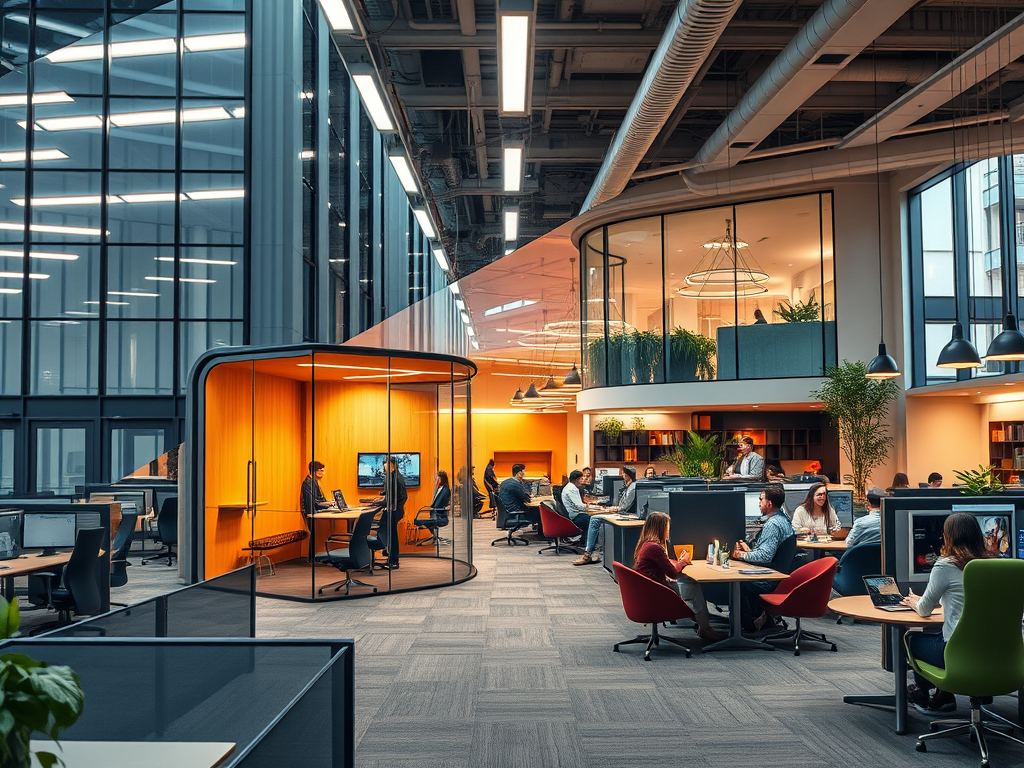
Modern companies are shrinking their real estate footprints and trading rows of desks for “Collaboration Hubs.” In these spaces, you won’t find assigned seating. Instead, you’ll find:
- Acoustic Pods: Small, soundproof booths for deep-focus calls.
- Huddle Rooms: Tech-enabled spaces designed specifically for “Phygital” meetings—where half the team is in the room and the other half is a 4K hologram on the wall.
- Community Lounges: Areas designed for the one thing Zoom can’t do: spontaneous, “watercooler” innovation.
From Attendance to “Outcome Culture”
For decades, management was based on “Presenteeism.” If your boss saw your back in a chair, you were working. This was always a lazy metric, but technology has finally killed it.
We have moved into an Outcome-Based Economy. With the integration of Agentic AI—smart assistants that can manage schedules, draft reports, and summarize meetings—the “busy work” that used to fill an eight-hour office day is being automated away.
What’s left? Impact work. I recently spoke with a marketing director who moved her entire team to a “Work from Anywhere” model. She told me, “I don’t care if my lead designer works from a balcony in Portugal or a library in Ohio. I care that our campaign ROI is up 20%. The office was a leash; the cloud is a launchpad.”
The “Third Space” and the Death of the Commute
The most exciting development isn’t happening at home or in the headquarters—it’s happening in the “Third Space.” As traditional offices close, we are seeing a boom in neighborhood micro-hubs. Think of these as high-end, professional versions of your favorite coffee shop. Professionals are no longer choosing between a 60-minute commute to a “Main Office” or the isolation of a kitchen table. They are walking five minutes to a local co-working spot where they can find community without the corporate bureaucracy.
Why This is Better for Your Brain (and the Planet)
The data is becoming undeniable. When people have autonomy over their environment, several things happen:
- Cognitive Load Drops: No more “open office” distractions like Nancy from accounting microwaving fish or Jim’s loud phone calls.
- Sustainability Skyrockets: Less commuting means a massive reduction in carbon footprints.
- The Talent Pool Explodes: Companies are no longer limited to hiring the best person within a 30-mile radius; they can hire the best person on the planet.
The Survival Guide for the New Era
If you are still tethered to an old-school office model, the transition can feel daunting. But the “End of the Office” is actually the beginning of your professional freedom. To thrive in this new landscape, you need to shift your mindset:
- Invest in Your “Digital Headquarters”: Your home setup isn’t just a desk; it’s your primary tool. High-quality audio and lighting are the new “power suit.”
- Master Asynchronous Communication: Learn to contribute to projects without needing a real-time meeting. Documentation is the new currency of leadership.
- Prioritize “Social Capital”: Because you aren’t seeing people daily, you must be intentional. Book “coffee chats” that have nothing to do with tasks and everything to do with connection.
Your Next Step: The “Environment Audit”
The office isn’t coming back, and that’s a good thing. But freedom requires a plan.
Your Call to Action: This week, perform an “Environment Audit.” Track your productivity for three days. Where were you when you did your best work? Was it at a quiet desk? A bustling cafe? A park? Once you identify your “Peak Performance Zone,” start a conversation with your manager or team about how to structure your week around output, not location.
The walls are coming down. It’s time to decide where you want to build your future.
#FutureOfWork #RemoteWork #WorkFromAnywhere #OfficeDesign #DigitalNomadLife
Disclaimer: This article is for informational purposes only and does not constitute professional or management advice. The shift toward remote and hybrid work models varies significantly by industry and individual role. Always consult with your HR department or a professional career coach before making significant changes to your working arrangements.
Leave a Reply