
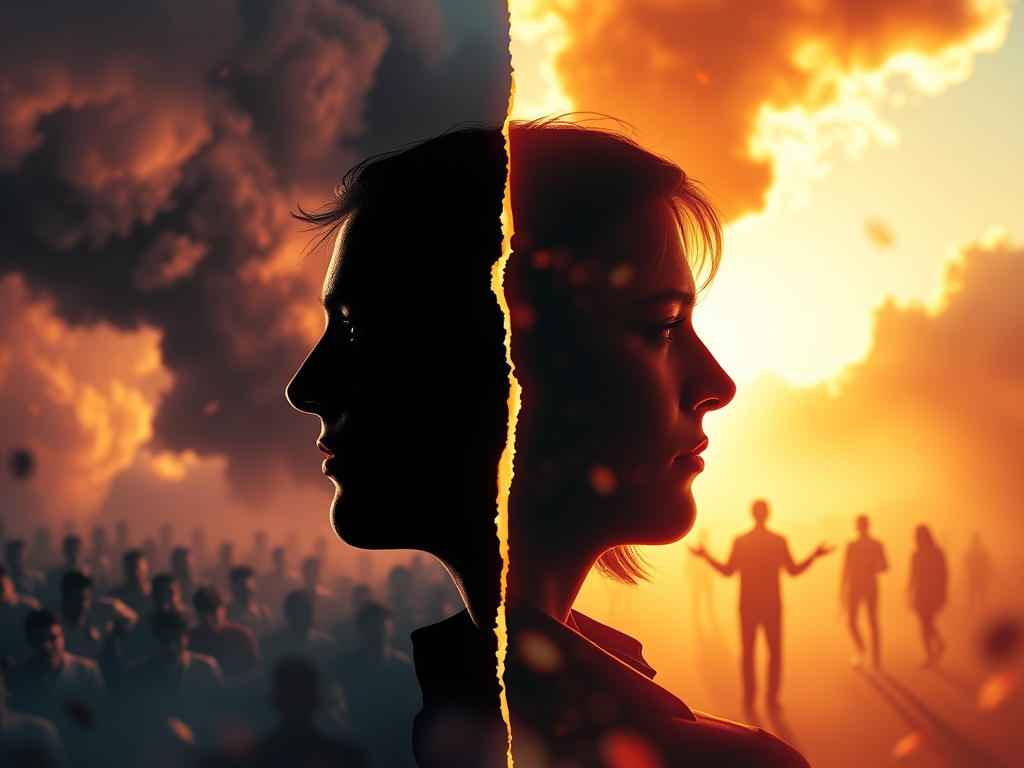
Most people say they want unity.
Yet many quietly feel more comfortable in division.
This contradiction is rarely discussed because it is unsettling. It suggests that polarization is not only something happening to society. It is something happening inside each person.
The deeper truth is that polarization is not primarily political. It is psychological.
Why Polarization Feels Personal
The modern world exposes us to more perspectives than any generation before. This sounds like progress. But exposure without trust does not create openness. It creates threat.
When people encounter ideas that challenge their beliefs, the brain interprets it as a risk to identity. Not just disagreement. Loss of stability.
This is why arguments today feel emotional even when the topic appears rational. The reaction is not about facts. It is about belonging.
Most people do not consciously choose sides because of ideology. They choose sides because uncertainty feels dangerous.
The Hidden Comfort of Certainty
Certainty reduces anxiety. Even if it is incomplete or distorted.
In earlier societies, stability came from shared narratives. Religion, culture, and community created a common framework. Today those structures are weaker. Technology has multiplied perspectives but reduced agreement.
Without shared ground, people seek emotional safety. Polarization provides it.
When someone joins a strong group identity, they receive clarity. They know who they are. They know who they are not. The world becomes easier to navigate.
This explains why extreme positions often grow faster than moderate ones. Extremes remove ambiguity.
Moderation requires patience and complexity. Extremes offer immediate relief.
Algorithms Did Not Create This Problem
It is tempting to blame technology alone. But algorithms amplify instincts that already exist.
Digital platforms reward emotional intensity because intense content holds attention. Attention is profitable. Over time this creates an environment where outrage travels faster than reflection.
Yet the deeper issue is human vulnerability to emotional shortcuts.
People share content that confirms their worldview because it feels stabilizing. They attack opposing views because it strengthens group bonds. These reactions are not always conscious. They are protective.
Technology did not invent tribal thinking. It industrialized it.
The Loneliness Beneath the Conflict
Polarization is often described as anger. But beneath anger is isolation.
Many individuals feel invisible in complex societies. When someone finds a group that recognizes their fears or frustrations, the connection is powerful. Even if the group defines itself through opposition.
This is why hostility can coexist with belonging. Conflict becomes a pathway to connection.
The more fragmented society becomes, the more this dynamic intensifies.
People do not just defend ideas. They defend the relationships built around those ideas.
The Fear of Being Wrong in Public
Another silent force behind polarization is reputational risk.
In a hyperconnected world, mistakes are permanent and visible. Changing one’s mind publicly can feel humiliating or dangerous. This discourages nuance.
Instead of evolving, many double down. They become more rigid not because they are certain, but because retreat feels costly.
The result is a society where private doubt coexists with public certainty.
This gap fuels mistrust.
Why Dialogue Feels Harder Than Ever
True dialogue requires vulnerability. It means risking status and belonging.
But modern communication often removes context. Short messages replace shared experiences. Tone is misinterpreted. Intentions are assumed.
Without trust, conversation becomes performance.
People do not ask questions to understand. They ask questions to win.
This creates exhaustion. Many withdraw from discussion entirely. Others engage only with those who agree.
Both reactions increase distance.
The New Form of Power
The ability to divide has become a strategic advantage.
Organizations, movements, and media outlets can mobilize attention by intensifying differences. This is efficient. It drives engagement and loyalty.
But it also reshapes perception. Over time, people begin to see conflict as normal and cooperation as naive.
This quiet normalization is more dangerous than any single argument.
Because once division becomes default, rebuilding trust becomes slow and fragile.
A Different Way Forward
Reducing polarization does not require everyone to agree. It requires psychological safety.
People need spaces where they can explore ideas without immediate judgment. Where uncertainty is not punished. Where complexity is not seen as weakness.
This will not come from large institutions alone. It will emerge in smaller networks. Communities built on curiosity rather than identity.
The future may belong to those who can hold tension without collapsing into certainty.
This is not easy. It feels uncomfortable. It requires patience in a culture that rewards speed.
But there is a quiet shift already happening. Many are tired of constant conflict. They want depth. They want understanding. They want to think without being forced into a side.
Polarization thrives on urgency.
Clarity grows in stillness.
The challenge for the coming years is not only technological or political.
It is emotional.
Can we tolerate complexity long enough to rediscover each other?
Disclaimer: This article is for educational and informational purposes only and reflects evolving perspectives on society, psychology, and digital culture.
#Polarization #Psychology #DigitalCulture #FutureSociety #Feereet
Leave a Reply