
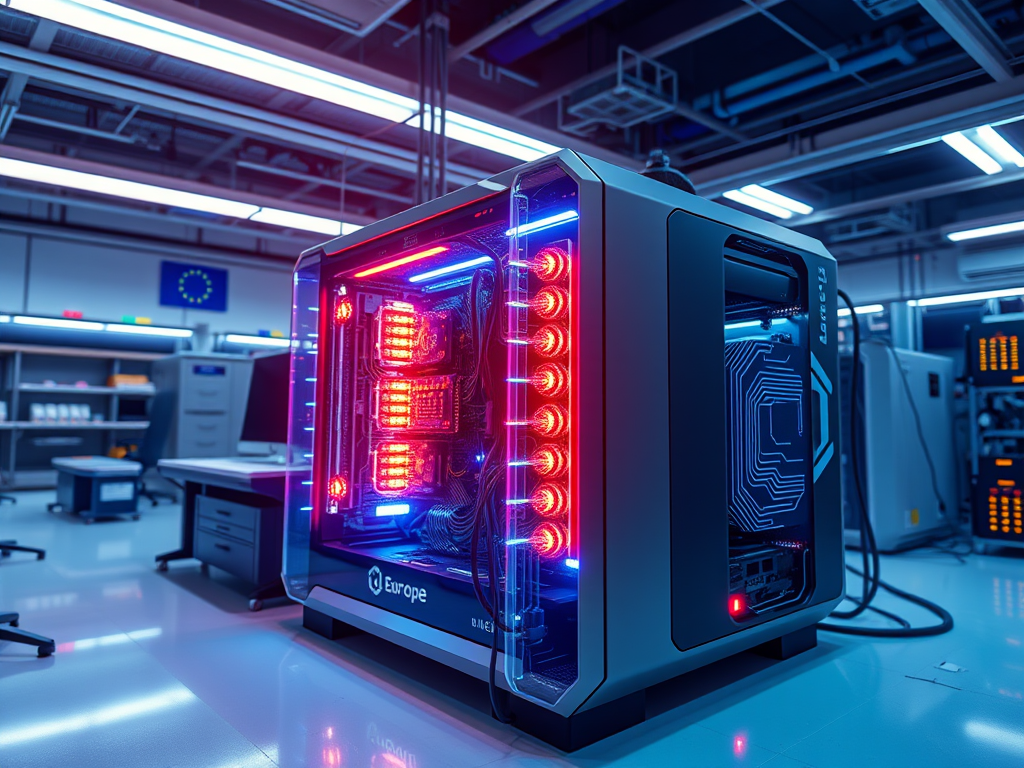
A technology is being built right now that will make today’s most powerful supercomputers look like pocket calculators. Quantum computing could break the encryption protecting your bank account, accelerate drug discovery by decades, and reshape global military and economic power in ways that make the AI race look like a warm-up act. Europe is in this race. The question is whether it is running fast enough.
What Is Quantum Computing and Why Does It Matter So Much?
Classical computers, every laptop, smartphone, and data centre operating today, process information as bits. A bit is a single unit of information that can be either 0 or 1. Everything a classical computer does, every calculation, every piece of data processed, every decision made, comes down to combinations of those two states.
Quantum computers work on a fundamentally different principle. They use qubits (quantum bits, the basic unit of quantum information) which can exist in a state of 0, 1, or both simultaneously, a property called superposition. Combined with entanglement (a quantum phenomenon where qubits become linked so that the state of one instantly affects the other regardless of distance) and interference (the ability to amplify correct answers and cancel out wrong ones), quantum computers can perform certain types of calculations at speeds that are not just faster than classical computers but categorically different in kind.
To put this concretely: a problem that would take a classical supercomputer millions of years to solve could theoretically be solved by a sufficiently powerful quantum computer in hours or minutes. The kinds of problems that fall into this category include breaking current encryption systems, optimising enormously complex logistical networks, simulating molecular behaviour for drug and materials discovery, and modelling financial systems with a level of complexity currently impossible.
This is why governments and major technology companies are spending billions on quantum computing research. It is not a niche academic interest. It is a technology with direct implications for national security, economic competitiveness, and the protection of every encrypted communication sent anywhere in the world.
Where Europe Currently Stands
The EU launched its Quantum Flagship programme in 2018, a ten-year initiative with a total budget of one billion euros designed to transition quantum technologies from laboratory research to commercial and societal applications. The programme funds research consortia across member states, supports the development of quantum hardware and software, and aims to build a European quantum industry capable of competing on the global stage.
One billion euros sounds significant. In the context of the global quantum race, it requires honest assessment. The United States has committed substantially more through a combination of federal programmes, DARPA funding (the US defence research agency), and private investment from companies like IBM, Google, and Microsoft that have quantum research programmes with individual budgets that approach or exceed the entire EU Flagship allocation. China’s national quantum investment is estimated by analysts to run into the tens of billions of dollars, with quantum communication infrastructure already deployed at national scale including a quantum satellite communication network.
Europe’s advantage is not in the scale of its investment but in the quality and breadth of its research base, the collaborative framework that allows talent and resources to be coordinated across member states, and a regulatory and values environment that shapes how quantum technology will be developed and deployed.
Three European Efforts That Show What Is Possible
IQM Quantum Computers: Finland Leads Hardware
IQM Quantum Computers, founded in Helsinki in 2018 and now operating across Europe with a significant presence in Germany, is one of the continent’s most advanced quantum hardware companies. IQM builds superconducting quantum processors (chips that use superconducting circuits cooled to temperatures colder than outer space to create and manipulate qubits) and has delivered quantum systems to research institutions and national supercomputing centres across Europe.
In 2023 IQM installed a quantum computer at the Leibniz Supercomputing Centre in Bavaria, integrating quantum processing capability into one of Germany’s flagship high-performance computing facilities. This kind of quantum-classical hybrid deployment, combining the strengths of both computing paradigms, represents the most practical near-term path to quantum advantage in real-world applications and IQM is among the European leaders in making it work.
IQM’s approach of building quantum computers specifically for on-premises deployment rather than exclusively cloud-based access aligns with European priorities around data sovereignty (the principle that data and the systems processing it should remain under the legal jurisdiction of their owners) and is increasingly attractive to European institutions that are cautious about sensitive research or government data passing through American or Chinese quantum cloud infrastructure.
Pasqal: France Builds Neutral Atom Quantum Computers
Paris-based Pasqal is pursuing a different technical approach to quantum computing using neutral atoms (individual atoms held in place by laser beams and used as qubits) rather than the superconducting circuits that dominate the American quantum industry. Neutral atom quantum computers have specific advantages in the number of qubits they can operate simultaneously and in their potential for scaling to larger systems.
Pasqal has secured significant funding from French and European investors and has partnerships with major European industrial and research clients including EDF (the French energy company) exploring quantum applications in energy grid optimisation. The French government has been a strong supporter of Pasqal as part of its broader national quantum strategy, which committed 1.8 billion euros to quantum technology development, making France one of the highest per-capita quantum investors in Europe.
The existence of meaningfully different technical approaches within Europe, superconducting qubits from IQM, neutral atoms from Pasqal, photonic quantum computing being developed by other European startups, is actually a strategic strength. Quantum computing is still in a phase where it is genuinely unclear which technical approach will prove most scalable and practically useful. Diversity of approaches hedges against the risk of betting everything on one path.
Germany’s National Quantum Initiative
Germany has made quantum technology a centrepiece of its high-tech strategy, committing two billion euros to quantum computing research and development as part of its national recovery and future investment programmes. The German government has funded quantum computer installations at the Jülich Supercomputing Centre, supported IBM’s deployment of its quantum systems in Germany through a strategic partnership, and invested heavily in building a domestic quantum industry supply chain.
The German approach reflects a broader industrial policy logic. Quantum computing is expected to be transformative for chemistry, materials science, logistics, and financial modelling, all sectors where German industry has major stakes. BASF, BMW, Volkswagen, and Deutsche Bank are among the German corporate giants actively exploring quantum computing applications relevant to their businesses.
For the wider European ecosystem, Germany’s scale of investment and its integration of quantum research with established industrial application provides an important commercial pull that purely research-driven programmes lack. Quantum computing needs not just scientists building better qubits but companies willing to invest in figuring out what those qubits can actually do for real-world business problems.
Europe vs. the US and China: An Honest Assessment
The honest assessment of Europe’s position in the quantum race requires acknowledging the gap clearly before discussing how it might be closed.
The United States leads in the development of gate-based quantum computers (the most general-purpose form of quantum computing) through IBM’s Quantum Network, Google’s quantum AI division, and a growing ecosystem of startups backed by venture capital at a scale that European quantum companies have not yet attracted. Google’s 2019 claim of quantum supremacy (demonstrating a quantum computation that a classical computer could not practically perform) and its subsequent advances in qubit quality and error correction represent genuine milestones that European hardware companies have not yet matched.
China leads in quantum communication, having deployed the world’s first quantum satellite for unhackable communication and built a national quantum communication backbone infrastructure. Chinese investment in quantum sensing and cryptography applications is substantial and strategically focused on military and intelligence applications in ways that European and American programmes are not entirely comparable to.
What Europe leads in, and this matters more than it might initially appear, is quantum research talent density and the breadth of its academic quantum physics community. Many of the conceptual breakthroughs in quantum computing have European origins. The challenge has been translating that research excellence into commercial momentum and industrial deployment at the speed that the strategic situation demands.
The EU’s approach to this challenge through the Quantum Flagship, combined with national programmes in France, Germany, the Netherlands, and increasingly other member states, is creating a more coherent European quantum ecosystem than existed five years ago. The European Quantum Industry Consortium (QuIC) brings together companies, research institutions, and investors to coordinate European quantum strategy in ways that start to resemble the kind of organised industrial policy that China deploys as a matter of course.
What Quantum Computing Means for EU Citizens Right Now
Most of the practical quantum applications that will affect everyday life are still years away from commercial deployment. But one dimension of quantum computing has immediate policy relevance for every EU citizen today: post-quantum cryptography.
Current encryption methods, including the systems protecting your online banking, your medical records, your private communications, and the digital infrastructure of European governments, are theoretically vulnerable to a sufficiently powerful quantum computer. The timeline for when quantum computers will be powerful enough to break current encryption is debated, with estimates ranging from ten to twenty-five years, but the consensus among security researchers is that the transition to quantum-resistant encryption (new cryptographic methods designed to be secure against quantum attacks) needs to begin now because updating global encryption infrastructure takes many years.
The EU’s cybersecurity agency ENISA (European Union Agency for Cybersecurity) has been actively developing guidance on post-quantum cryptography for European institutions and businesses. ENISA’s recommendations follow the standards published by NIST (the American National Institute of Standards and Technology) in 2024, which finalised the first set of approved post-quantum cryptographic algorithms after years of international evaluation. European organisations that handle sensitive data, including the Baltic states’ digital government infrastructure that is so often held up as a model, need to begin planning their transition to these new standards now rather than waiting until quantum threat becomes immediate.
The Race Is Long and Europe Is Still Running
Quantum computing is not a race that will be decided in the next year or even the next five. It is a decades-long technological development with multiple phases, multiple approaches, and multiple points at which the current leaders could be overtaken by a breakthrough from an unexpected direction.
Europe’s position in this race is better than the headline funding comparisons suggest. The research base is world-class. The industrial application interest is strong. The regulatory environment, with its emphasis on data sovereignty and technology trustworthiness, creates specific demand for European quantum solutions that American or Chinese alternatives cannot easily satisfy. And the collaborative framework of the EU, which frustrates people constantly with its slowness and complexity, does eventually coordinate resources and talent in ways that matter at scale.
The real question is whether Europe will fund its quantum ambitions with the consistency and urgency the strategic situation demands, or whether quantum investment will remain concentrated in a few leading member states while the broader EU ecosystem develops at a pace that falls short of genuine competitiveness.
💬 Here is the question worth sitting with: Quantum computing will eventually be powerful enough to break the encryption protecting most of our digital lives. Governments and major institutions know this is coming and are beginning to prepare. Do you think ordinary citizens and small businesses in Europe will get the guidance and support they need to make the transition to quantum-safe security before the threat becomes real, or will this be another case where critical digital infrastructure changes happen around people rather than with them? Tell us in the comments.
#QuantumComputing #EUQuantum #QuantumTech #FutureTech #DigitalSovereignty
Leave a Reply