
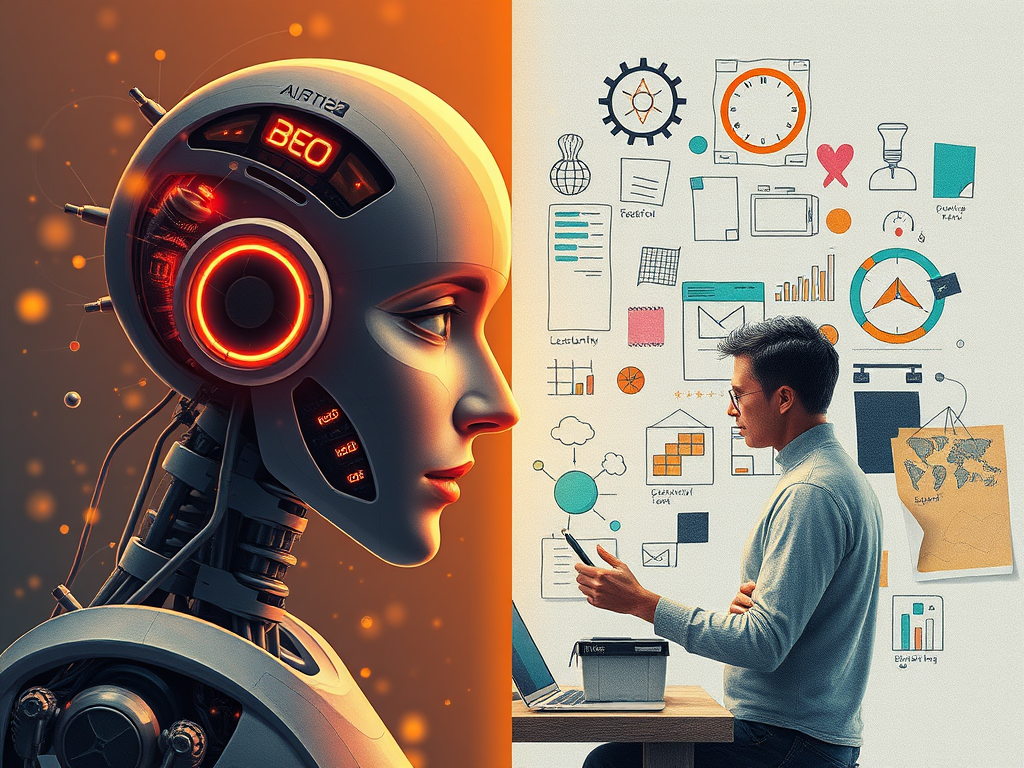
In a world where algorithms can write code, draft legal documents, and generate photorealistic images in seconds, a quiet but profound shift is happening in the global job market. For decades, we were told that “technical skills” were the ultimate insurance policy for a stable career. We memorized formulas, mastered specific software, and optimized for efficiency.
But as artificial intelligence reaches a state of maturity where it can mimic “good enough” execution, the value of pure technical output is plummeting. What is skyrocketing in its place? Human Creativity.
We are entering an era where it is no longer about how well you can use a tool, but about what you choose to build with it. Creativity is moving from the “arts and crafts” corner to the very center of business strategy. Here is why being a “creative” is becoming the most secure and high-valued position in the digital economy.
1. The “Sameness” Trap: Why Brands are Starving for Originality
As AI tools become ubiquitous, we are seeing a phenomenon called Brand Sameness. Because AI models are trained on existing data, they tend to produce results that represent the “mathematical average” of what already exists. If every company uses the same prompts to design their logos or write their ads, the entire internet begins to look and sound the same.
- The Insight: Efficiency is now a commodity. Anyone can be efficient with a chatbot.
- The Value: In a sea of “average” content, the human ability to introduce a quirk, a surprising metaphor, or a counter-intuitive strategy is the only thing that stands out. Creativity is the antidote to the algorithm.
2. From “Production” to “Architecting”
In the past, a creative professional spent 80% of their time on execution (drawing the lines, editing the video, formatting the slides) and 20% on the idea. Today, those numbers are flipping.
We are moving into a phase of Creative Orchestration. * The New Workflow: Instead of spending ten hours editing a video, you spend one hour directing an AI to handle the heavy lifting, and nine hours refining the story, the emotional resonance, and the unique “soul” of the project.
- The Skill: The most valuable professionals are those who can “architect” a vision. The value has moved from the hands to the judgment.
3. The Power of “Connective Intelligence”
Creativity isn’t just about painting or writing; it is about Pattern Recognition. One of the few things AI still struggles with is connecting two completely unrelated fields to create something brand new, like applying the principles of ancient architecture to modern user interface design.
- Human Edge: Humans possess “lived experience.” We understand the smell of rain, the sting of a breakup, and the specific cultural nuances of a local neighborhood.
- The Result: We can synthesize these “analog” feelings into digital products. This ability to bridge the gap between human emotion and technical systems is where the highest-paid consulting and design work currently lives.
4. Problem-Solving in High Definition
In the digital world, the most difficult problems aren’t technical, they are ambiguous. Computers are great at solving puzzles with defined rules. Humans are great at navigating “wicked problems” where the rules are missing or constantly changing.
- Creativity as Logic: Modern creativity is simply high-level problem-solving. It’s the ability to look at a failing business model and see a solution that isn’t in the data.
- The Advantage: While automation can optimize a path, only human creativity can decide which path is worth taking in the first place.
5. The Rise of the “AI-Native” Human
The most successful people in the next decade won’t be those who reject technology, nor those who let technology do all the work. They will be AI-Native Creatives. This means using AI as a “Co-Pilot” to explore thousands of ideas in the time it used to take to explore ten. By leveraging automation to handle the “boring” parts of the creative process, humans can spend more time being “unpredictable” which is exactly where innovation happens.
The Future Belongs to the Imaginative
We are moving away from an economy of knowledge (since all knowledge is now a click away) and toward an economy of imagination. If your job consists of following a set of instructions, it is at risk. If your job consists of deciding which instructions to write, you are more valuable than ever.
The “Creative Premium” is real. It’s time to stop worrying about the machines taking our jobs and start focusing on the one thing they can’t replicate, the uniquely human desire to make something that hasn’t been seen before.
Leave a Reply