
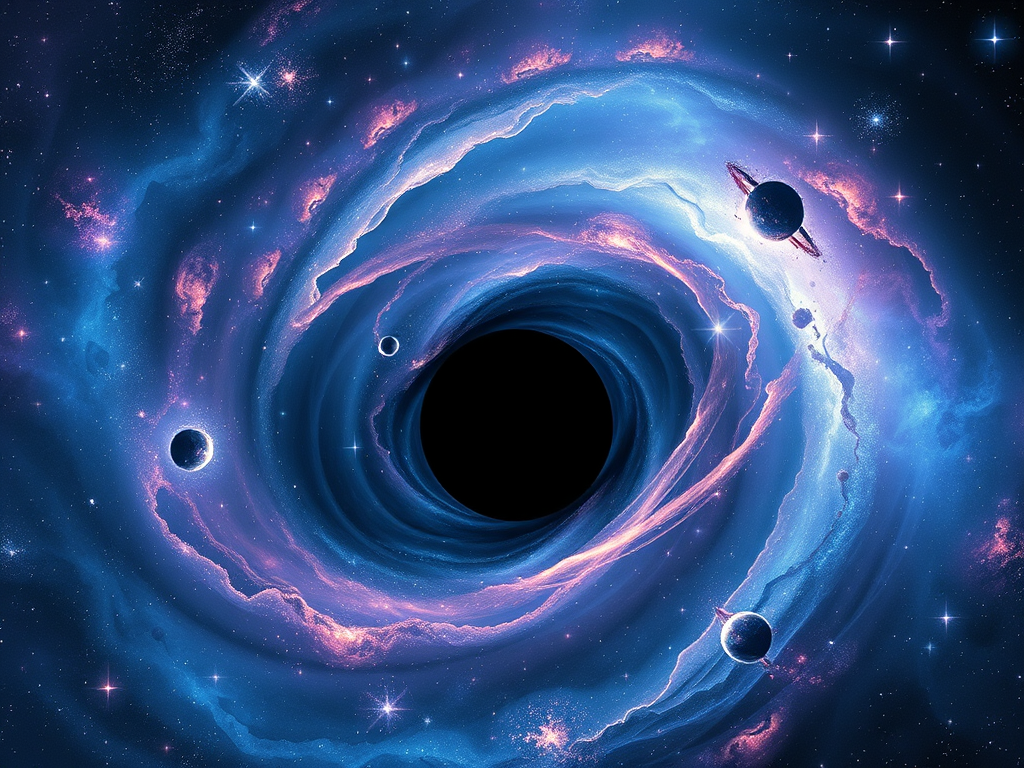
The universe is vast, elegant, and infinitely complex. Despite centuries of scientific breakthroughs, much of the cosmos remains a beautiful enigma. From dark energy that stretches spacetime to black holes that bend it beyond recognition, the universe teases us with puzzles that even our most advanced instruments struggle to decode.
Yet these mysteries are not roadblocks—they’re doorways to deeper understanding. As telescopes grow sharper and theories more precise, we inch closer to answers that could redefine not just physics, but our place in the cosmos.
Let’s explore the most compelling and awe-inspiring unsolved phenomena of the universe — and why the mystery is half the magic.
☄️ 1. What Is Dark Energy?
We know that the universe is expanding. But it’s not just expanding — it’s accelerating. That discovery shocked astronomers in the late 1990s. The culprit behind this cosmic push is something we call dark energy, a mysterious force that accounts for roughly 68% of the universe.
But what exactly is it?
No one knows.
Dark energy doesn’t emit light, doesn’t interact with matter, and isn’t made of particles like everything else we understand. It might be a property of space itself, a new type of energy field, or something else entirely.
Why it matters:
Understanding dark energy could unlock the secret to the universe’s ultimate fate — will it expand forever, rip apart, or collapse?
🕳️ 2. The Truth About Black Holes
Black holes are the cosmic vacuum cleaners of the universe — regions where gravity is so intense, not even light can escape. But they are far more than space oddities. They’re portals into the limits of physics.
Einstein’s theory of general relativity explains black holes well on a large scale. But at the center of every black hole is a singularity — a point where gravity becomes infinite and our current laws of physics break down completely.
Are they gateways to other dimensions? Can information really escape them as Stephen Hawking once suggested? Or are we just scratching the surface?
Why it matters:
Black holes could hold the key to a long-sought theory that unites quantum mechanics and gravity — the so-called “Theory of Everything.”
🌑 3. What Makes Up Dark Matter?
If dark energy is the force pushing the universe apart, dark matter is the invisible glue holding galaxies together. Accounting for about 27% of the universe, dark matter doesn’t emit, absorb, or reflect light. We only know it exists because of how it gravitationally influences visible matter.
But what is it?
Many theories point to exotic particles like WIMPs (Weakly Interacting Massive Particles) or axions, but no direct evidence has been found. Countless experiments — including deep underground detectors and space telescopes — are hunting for these ghostly particles.
Why it matters:
Without dark matter, galaxies would fly apart. Unlocking its identity would reshape our understanding of cosmic structure and formation.
🧠 4. Is the Universe Conscious?
This might sound more like philosophy than science, but it’s a question being asked by a growing number of researchers in physics and neuroscience. Some theories suggest that consciousness is a fundamental feature of the universe — just like space or time.
This line of thought is bolstered by phenomena in quantum mechanics, where particles seem to “choose” their state only when observed. Could consciousness play a deeper role in reality than we understand?
Why it matters:
If consciousness is indeed embedded in the fabric of the universe, it opens up revolutionary ideas about existence, perception, and purpose.
🌀 5. What Came Before the Big Bang?
The Big Bang theory explains how the universe expanded from a hot, dense state — but it doesn’t explain what came before. Did time exist? Was there a previous universe? Or is the Big Bang part of a never-ending cycle of expansion and collapse?
Some cutting-edge ideas propose a multiverse — an infinite number of universes, each with its own laws of physics. Others suggest that time itself began with the Big Bang, making “before” a meaningless concept.
Why it matters:
Answering this question could help us understand the origin of time, space, and reality itself.
🌠 6. Are We Alone in the Universe?
With billions of galaxies, each containing billions of stars and planets, it seems statistically unlikely that Earth is the only cradle of life. Yet, the Fermi Paradox asks: “If the universe is so big and old, where is everybody?”
Despite decades of scanning the skies, no conclusive evidence of extraterrestrial intelligence has been found. But new discoveries — like Earth-sized planets in habitable zones and complex organic molecules in deep space — suggest we may be getting closer.
Why it matters:
Finding life elsewhere would change everything — religion, science, culture — and prove that life is a cosmic phenomenon, not just an Earth-bound accident.
🔬 Technology Is Catching Up to Curiosity
We may not have all the answers, but what we do have is unprecedented access to data and tools. New missions like the James Webb Space Telescope, AI-powered simulations, and next-gen particle colliders are revealing more about the universe every day.
The more we learn, the more profound — and humbling — the questions become. The universe isn’t just a place we live in. It’s a grand puzzle that asks us to think bigger, reach farther, and never stop exploring.
🌈 Why Embracing the Unknown Is a Good Thing
Living in a universe full of mysteries is a privilege, not a problem. It means there’s more to learn, more to discover, and more to dream about. Whether you’re a scientist, student, or simply a stargazer, the unknown invites us to look up and ask, what if?
So the next time you glance at the night sky, remember: it’s not just a backdrop to our lives — it’s the greatest mystery story ever written. And we’re all a part of it.
#CosmicMysteries #DarkEnergyDebate #BlackHoleTruths #ExploringTheUniverse #GalacticCuriosity
Leave a Reply