
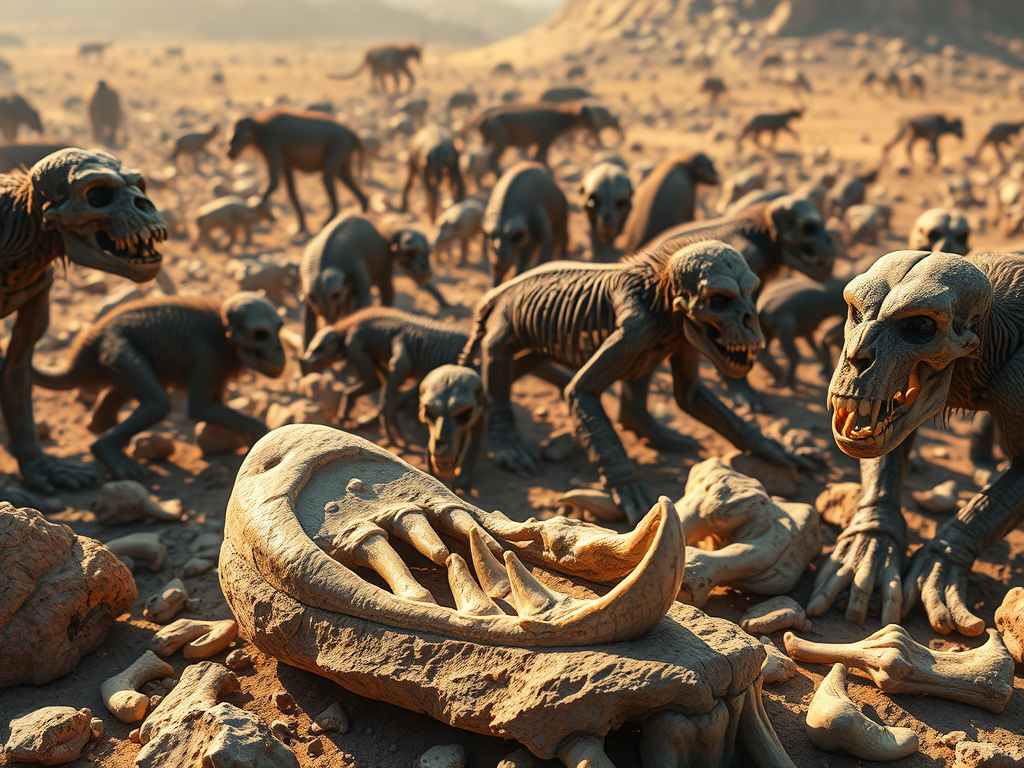
The story of human origins is not a simple, straight line. For decades, many of us envisioned a linear progression, a tidy ladder of evolution from ancient apes to modern humans. But recent breakthroughs in archaeology and genetic science are painting a far more complex, fascinating, and “bushy” picture of our family tree. The latest fossil finds and cutting-edge ancient DNA analysis are not just adding new chapters to our story, they’re rewriting the book entirely.
So, what’s new? The biggest shift in our understanding comes from the realization that multiple hominin species once coexisted, interacting and competing on the ancient African landscape.
The Fossil Record’s Radical Rethink
At the Ledi-Geraru site in Ethiopia, a thrilling discovery has shaken up the conventional timeline. Researchers have found fossils dating back between 2.6 and 2.8 million years, revealing that ancient members of the genus Australopithecus and early members of the genus Homo (our own lineage) lived in the same place at the same time. This is a monumental finding. It challenges the long-held assumption that one species simply gave way to the next. Instead, the landscape was a bustling mosaic of different hominin species, each adapting to their environment in unique ways.
Among these finds are fossilized teeth that may belong to a previously unknown species of Australopithecus, different from the famous “Lucy” (Australopithecus afarensis). This discovery underscores that our evolutionary past was a dynamic, sprawling network of branches, many of which led to dead ends. It suggests that the path to Homo sapiens was not a solo journey but a complex story of survival, extinction, and adaptation within a crowded world of ancient relatives.
The Unseen Story in Our Genes
If fossils are the bones of our history, ancient DNA is the living, breathing chronicle. The field of paleogenomics has revolutionized our ability to look back in time, revealing a hidden story of interbreeding and migration that fossils alone could never tell.
Beyond the well-known interbreeding with Neanderthals and Denisovans, new research has unveiled a more profound mixing event in our distant past. Scientists using advanced computational models have found evidence that modern humans are the result of a genetic fusion between two ancient populations that diverged over a million years ago. Roughly 300,000 years ago, these two groups came back together, with one contributing 80% of our genetic makeup and the other accounting for the remaining 20%. This suggests that our origins are far more complex than a single lineage evolving in isolation.
Moreover, DNA has revealed the lasting legacy of our extinct cousins. Studies show that a specific genetic variant, passed from Denisovans to Neanderthals and then to modern humans, may have helped the first people to migrate into the Americas. This gene, which is involved in the formation of mucus, may have provided an evolutionary advantage by helping them fight off new pathogens in a new environment. This is a powerful testament to how interbreeding with other human groups provided us with a “shortcut” to adapting to new challenges, introducing valuable genetic variation that would have otherwise taken thousands of years to develop.
Ancient DNA is also shedding light on why our species thrived while others, like the Neanderthals, disappeared. One study points to a subtle, but potentially crucial, genetic difference in a key enzyme that affects brain activity. While the findings are still being explored, they hint at the possibility that minor biochemical distinctions may have given Homo sapiens a cognitive edge, helping us outcompete our ancient relatives.
The Great Expansion: More Than One Journey
The “Out of Africa” theory, which posits that all non-African modern humans descended from a single expansion, is also being refined. While the core idea holds, new research suggests that there were multiple, earlier attempts to leave the continent that ultimately failed. What made the last, most successful migration different?
Scientists believe that the key was not just following “green corridors” created by favorable climate, but rather a newfound “ecological flexibility.” Before their successful expansion into Eurasia, our ancestors began to thrive in a wider range of African habitats, from dense forests to harsh deserts. This adaptability, born from coping with climatically challenging environments, may have been the crucial factor that allowed them to successfully disperse across the globe, while earlier, less flexible groups did not survive.
This new understanding paints a picture of our ancestors not as a single, homogenous group, but as a species defined by its adaptability and resilience. The story of humanity is a story of diversity, not just in the modern world but deep in our evolutionary past.
Conclusion: The Unfolding Story
The discoveries of new fossils and the insights from ancient DNA have brought us to a thrilling point in our understanding of human origins. The linear timeline has been replaced by a dense, interconnected family tree. We now know that our past is filled with complex interactions, extinctions, and remarkable instances of genetic exchange that continue to influence us today. The search for our origins is far from over—every new discovery adds another layer to our shared, intricate history.
#HumanOrigins #AncientDNA #FossilFinds #Paleoanthropology #Evolution
Leave a Reply