
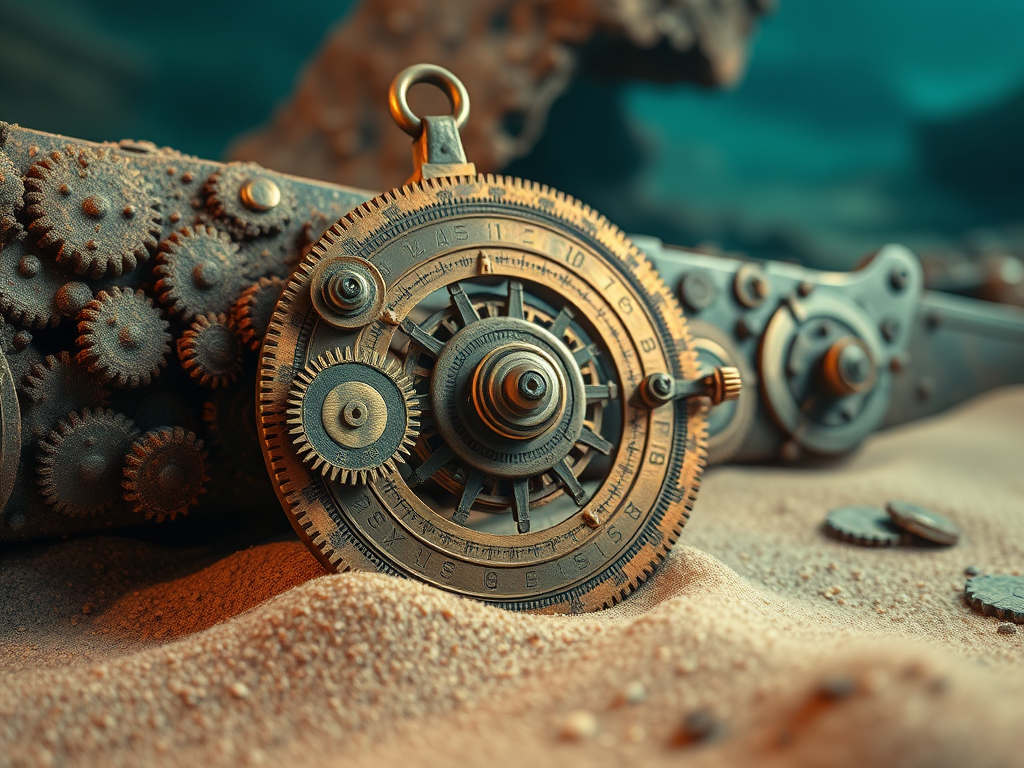
Our history books are filled with grand narratives of empires, conquests, and the steady march of human progress. We believe we have a solid grasp on the past, yet every so often, an object emerges from the sands of time that completely rewrites the story. These are not just relics; they are enigmas forged in metal, carved in stone, or transcribed on vellum. They are a testament to the fact that the ancient world was far more complex, and perhaps more advanced, than we ever imagined.
These mysterious ancient artifacts challenge our conventional timelines of technology and knowledge. They force us to ask a simple, yet profound question: what else don’t we know about our own past? Rather than being frustrating dead ends, these objects are invitations—beckoning us to explore the hidden chapters of history and celebrate the incredible ingenuity of those who came before us. This is a journey into the heart of history’s greatest riddles, a positive exploration of the artifacts that defy explanation.
The Antikythera Mechanism: A Computer from the Ancient World
Discovered in a shipwreck off the coast of a Greek island, the Antikythera Mechanism is arguably the most complex and awe-inspiring artifact ever found. At first glance, it appeared to be a corroded lump of bronze. After decades of painstaking research and advanced x-ray analysis, a team of scientists revealed its true nature: a sophisticated, hand-powered analogue computer.
Dating back to around 100 BCE, this intricate device contained a dizzying array of over 30 precisely machined bronze gears, dials, and pointers. It was an orrery, a mechanical model of the solar system, used to track the cycles of the sun, moon, and planets. Its complexity was a thousand years ahead of its time, surpassing anything known from the ancient world and even pre-dating medieval clockmaking by centuries. It could accurately predict eclipses and track the four-year cycle of the ancient Olympic Games.
The mere existence of the Antikythera Mechanism challenges the narrative of a linear progression of technology. It proves that the ancient Greeks possessed a mastery of engineering and mathematical astronomy that was not replicated for over a millennium. It is a powerful reminder that our ancestors were capable of incredible feats of brilliance, some of which we are only just beginning to comprehend.
The Voynich Manuscript: A Book That Cannot Be Read
For centuries, a bizarre and beautiful book has confounded the world’s best cryptographers, historians, and linguists. The Voynich Manuscript, a 240-page codex filled with strange illustrations and an unknown script, is a mystery in a class of its own. Carbon-dated to the early 15th century, the book is divided into sections, with drawings of unusual, unidentifiable plants, intricate astrological charts, and what appear to be diagrams of bathing women and cosmological maps.
The core of the mystery is its unreadable text. No one has ever been able to decipher the script. It does not appear to be a known language, and its statistical properties suggest it is not a simple substitution cipher. This has led to a fascinating range of theories. Some believe it’s an elaborate hoax, a meaningless collection of gibberish designed to fool collectors. Others argue it is a lost or invented language, an enciphered text meant to protect esoteric knowledge, or even a medical herbal for a secret society.
The Voynich Manuscript stands as a testament to a knowledge or a history that is completely lost to us. Its vibrant illustrations and cryptic text are a direct challenge to our understanding, and it remains one of the world’s most tantalizing unsolved puzzles.
The Baghdad Battery: An Ancient Electrical Mystery
When German archaeologist Wilhelm König discovered a small clay jar in Baghdad in 1936, he noticed something peculiar. The jar, dating back to the Parthian era (around 250 BCE to 224 CE), contained a copper cylinder and an iron rod. He hypothesized that this was no ordinary pot; it was an ancient battery.
The Baghdad Battery is a simple yet revolutionary concept. If filled with an acidic liquid like grape juice or vinegar, the combination of the copper and iron would create a small electrical current. Experimental replicas have proven this. So, what was it used for? The theories are as diverse as they are fascinating.
- Electroplating: König’s original theory suggested it was used for electroplating gold onto silver, but archaeologists have found no artifacts from this period that show signs of this technique.
- Medical Use: Some have proposed it was used for a form of electrotherapy to relieve pain.
- Ceremonial Purposes: Others believe it was used in religious ceremonies, perhaps to give a jolt to a statue to make it appear as though it were “alive” or divine.
While its purpose remains a subject of intense debate, the Baghdad Battery stands as a tantalizing hint that our ancestors may have experimented with electricity centuries before its official discovery.
The Roman Dodecahedra: Objects with No Purpose
Scattered across the ancient Roman Empire, from Britain to Hungary, lie over a hundred small, hollow objects of unknown purpose. The Roman Dodecahedra are precisely cast in bronze, with 12 flat faces, each with a circular hole of varying size. They are adorned with knobs at each vertex, and their craftsmanship is exquisite.
Despite centuries of archaeological digs, not a single one has been found with an accompanying inscription or illustration that explains its function. Their location—found in military camps, urban centers, and even graves—provides no clear answer. The theories are a testament to our modern confusion. Are they:
- A Surveying Tool: A device used by engineers to measure distances or angles?
- A Candle Holder: Perhaps they were used to hold a candle on each knob?
- A Religious Artifact: Could they have been used in a forgotten pagan ritual?
- A Toy or Game: Were they a part of a complicated Roman board game?
The sheer range of possibilities highlights how little we truly know about these mysterious objects. The fact that their purpose is still a complete enigma is a powerful reminder that history is filled with missing pieces.
The Piri Reis Map and the Quimbaya Airplanes
Two other artifacts add to the rich tapestry of historical mystery. The Piri Reis Map, compiled in 1513, shows a remarkable level of cartographic detail, including what appears to be the coast of South America and a landmass some have speculated is Antarctica, without ice. While modern research has largely debunked the Antarctica theory, the map’s existence and its use of a now-lost map from Christopher Columbus and other unknown sources hint at a sophisticated global knowledge that has since vanished.
Similarly, the Quimbaya artifacts found in Colombia are small, golden figurines that are said to represent stylized animals. However, a closer look reveals that some of them possess an uncanny resemblance to modern-day airplanes, complete with what look like wings, stabilizers, and rudders. While archaeologists maintain they are zoomorphic figurines, the uncanny aerodynamic design has fueled speculation that they are models of ancient flying machines. The mystery of their design continues to intrigue and inspire.
The Ongoing Quest for Answers
These mysterious artifacts are more than just archaeological curiosities. They are symbols of the vast knowledge we have yet to uncover about our own past. They serve as a powerful reminder that history is not a static text but an evolving story, filled with chapters that are still unwritten. The ongoing quest to understand these objects drives innovation in technology and research, pushing us to develop new ways to analyze the past. In celebrating these mysteries, we celebrate the enduring spirit of human ingenuity and the boundless potential of the human mind, both then and now.
#AncientMysteries #UnexplainedArtifacts #ArchaeologicalFinds #AncientTechnology #HistoricalPuzzles
This video offers a fascinating look at these and other artifacts.
Leave a Reply