
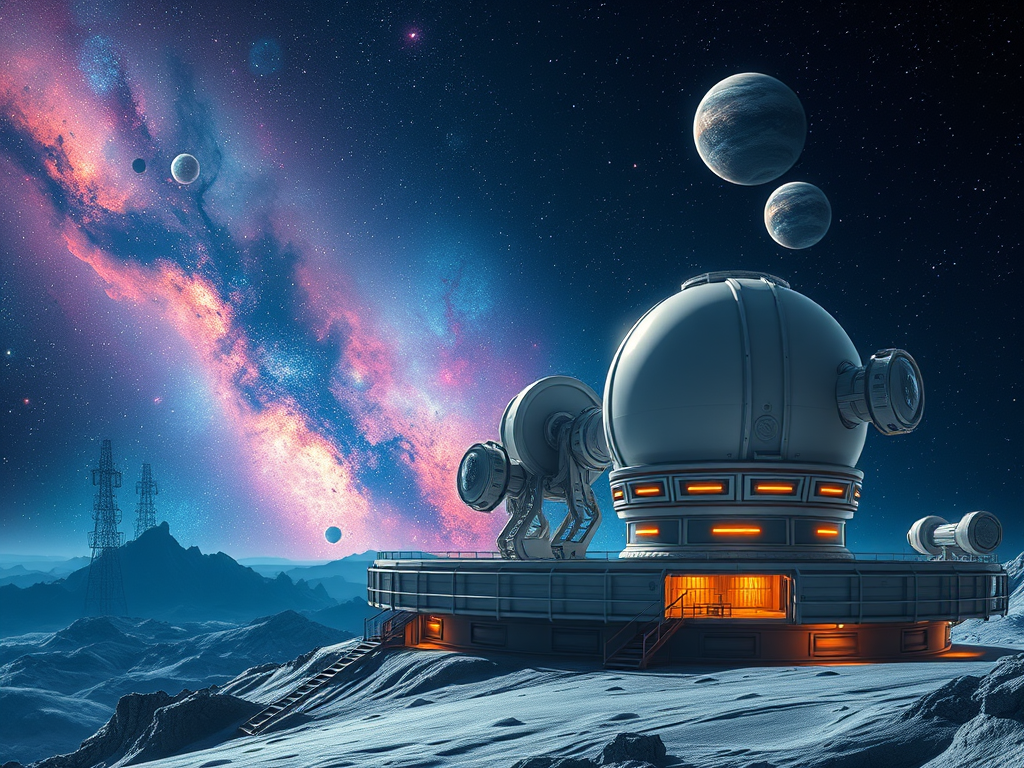
For centuries, humans have looked to the stars wondering, Are we alone in the universe? Today, thanks to cutting-edge technology and a better understanding of planetary science, the search for extraterrestrial life has become one of the most exciting frontiers in modern science. Central to this effort is the quest for biosignatures—scientific evidence of life, past or present, beyond Earth.
From ancient Martian lakes to the distant atmospheres of exoplanets, scientists are chasing subtle but powerful signs that life may not be exclusive to our pale blue dot. As the cosmos reveals its secrets, we’re getting closer than ever to answering one of humanity’s oldest and most profound questions.
What Are Biosignatures?
A biosignature is any substance—or combination of substances—that provides scientific evidence of past or present life. These can include:
- Specific gases in a planet’s atmosphere (like oxygen or methane)
- Organic molecules associated with biological processes
- Isotopic ratios indicating metabolic activity
- Microbial fossils or textures preserved in rocks
- Chemical imbalances that are difficult to explain without biology
Unlike direct observation of alien life, biosignatures allow scientists to detect the effects of life—like footprints in the sand, rather than seeing the traveler.
Why the Focus on Exoplanets?
Since the launch of powerful telescopes like Kepler and the more recent James Webb Space Telescope (JWST), astronomers have identified thousands of exoplanets—planets orbiting stars outside our solar system. Many of these planets lie in the so-called habitable zone, the region around a star where temperatures could allow liquid water to exist.
These alien worlds are now prime candidates for biosignature detection. JWST and future observatories are already analyzing their atmospheric compositions, searching for combinations of gases that hint at life. For instance, oxygen and methane together are considered strong biosignatures, since they tend to react with each other and must be continuously replenished—potentially by living organisms.
Mars: The Original Biosignature Hunt
Closer to home, Mars has long fascinated scientists in the search for extraterrestrial life. Rovers like Perseverance and Curiosity are actively studying the Martian surface, seeking ancient signs of microbial life.
Recent discoveries include:
- Organic molecules in ancient lakebeds
- Seasonal spikes in methane levels
- Sedimentary rock formations resembling Earth’s microbial mats
Though none of these findings confirm life, they suggest Mars once had conditions suitable for life and may still harbor microbial remnants today.
Ocean Worlds: Hidden Potential Under Ice
Beyond Mars, icy moons like Europa (Jupiter) and Enceladus (Saturn) have become hotspots for astrobiology. Beneath their frozen crusts lie liquid water oceans, warmed by internal heat and rich in salts and possibly even hydrothermal activity—an environment not unlike Earth’s deep-sea vents where life thrives without sunlight.
In fact, NASA’s Cassini spacecraft detected plumes of water vapor and organic compounds erupting from Enceladus, sparking excitement that life’s building blocks may already exist beneath the surface.
Upcoming missions like Europa Clipper aim to probe these worlds more deeply, potentially sampling material ejected into space for signs of life.
Earth’s Extremophiles: Proof That Life Finds a Way
One reason scientists are optimistic about life beyond Earth is because of extremophiles—microorganisms on Earth that thrive in environments once thought uninhabitable. These hardy organisms live in:
- Boiling hot springs
- Deep ocean trenches
- Acidic rivers
- Radioactive zones
- Ice-covered glaciers
If life can adapt to Earth’s most extreme conditions, it broadens the scope of where it might survive elsewhere in the universe. The key takeaway? Life is tenacious—and it might be more common than we once believed.
The Challenge of False Positives
Detecting biosignatures isn’t always straightforward. Some chemical processes can mimic life’s effects, leading to false positives. For instance, volcanic activity can release methane, and oxygen might be produced by photochemical reactions.
This is why scientists are cautious—context is everything. A true biosignature must fit a broader pattern that suggests a biological origin. That’s why missions don’t just look for one clue, but multiple lines of evidence across chemical, geological, and atmospheric data.
The Role of Artificial Intelligence and Big Data
Modern space exploration now leans heavily on artificial intelligence and machine learning to process the vast data coming from telescopes and rovers. These systems can:
- Analyze planetary atmospheres in real time
- Detect chemical anomalies
- Compare observations with massive biological databases
AI also plays a crucial role in designing new missions and identifying promising exoplanets that warrant closer inspection. As our datasets grow, these tools will help us narrow the search and improve the accuracy of biosignature interpretation.
Why the Search Matters
Beyond the thrill of potential discovery, the search for biosignatures challenges us to rethink our place in the universe. If we find life—or even evidence that it once existed—it will reshape science, philosophy, religion, and global perspective.
It could also answer key questions about life on Earth:
- Is life a cosmic imperative, or a fluke?
- Could life have originated more than once?
- Do all living systems follow the same biochemical rules?
Each step in this search teaches us more about life itself, making our own existence feel both more connected and more extraordinary.
The Next Decade: What to Watch
In the coming years, new space telescopes and planetary missions will accelerate the search for biosignatures. Key programs include:
- James Webb Space Telescope (JWST): already analyzing exoplanet atmospheres
- Europa Clipper: set to explore one of Jupiter’s most promising moons
- Extremely Large Telescope (ELT): capable of spotting oxygen on distant planets
- Dragonfly mission to Titan: exploring an atmosphere-rich moon of Saturn
These missions represent the dawn of a new era of astrobiology, where discovery is not only possible—it’s probable.
Final Thoughts
The universe is vast, mysterious, and full of potential. While we haven’t yet discovered definitive proof of life beyond Earth, the search for biosignatures brings us closer with each passing year. It’s not science fiction—it’s science in progress.
As technology sharpens our vision and curiosity fuels our ambition, the cosmos may soon whisper back an answer we’ve been longing to hear: You are not alone.
#SearchForLife #Astrobiology #Biosignatures #Exoplanets #SpaceExploration
Leave a Reply