
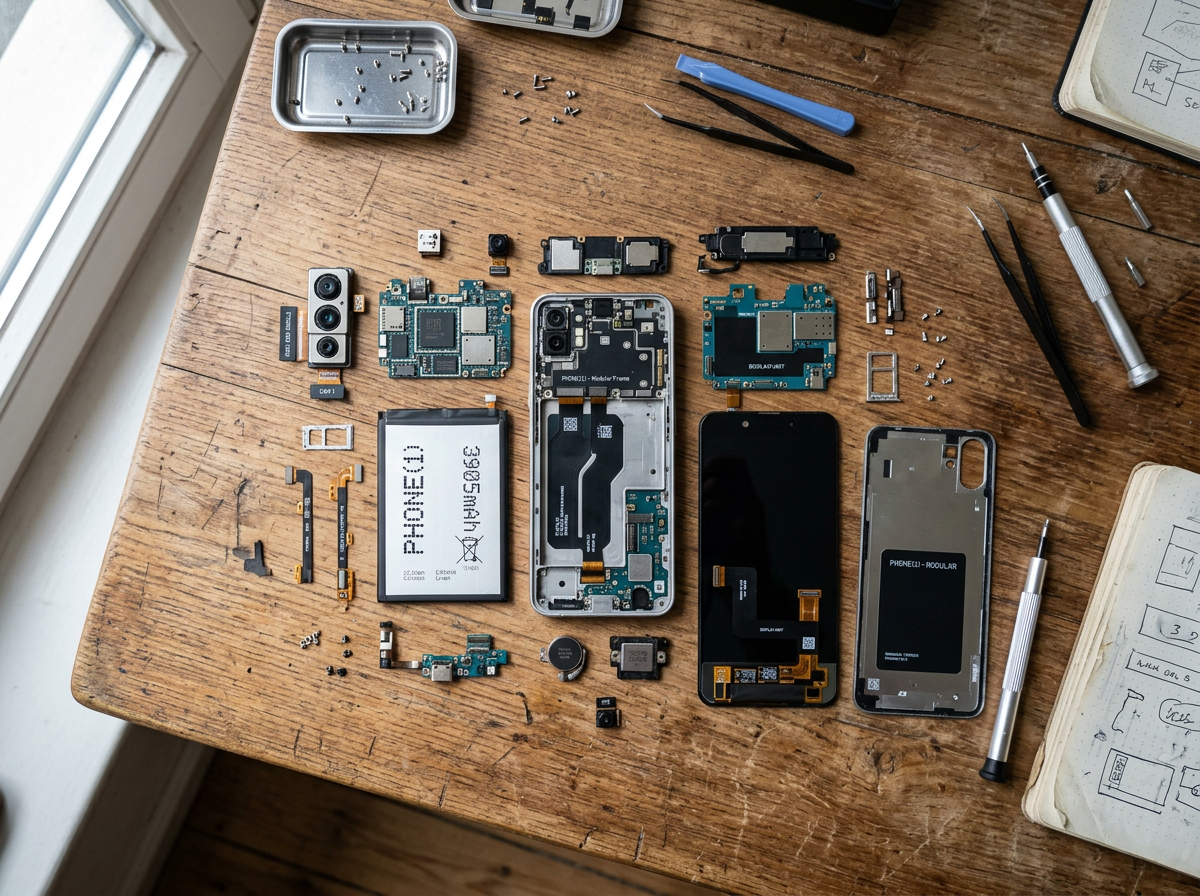
The era of the “disposable” smartphone is officially hitting a legal brick wall in Europe. For years, we accepted that a cracked screen or a dying battery meant buying an entirely new device, but in 2026, the tide has turned. Driven by a mix of conscious consumerism and groundbreaking EU laws, modular electronics have moved from a niche hobby to the center stage of the European tech market.
The Rise of the Repairable Rebel
To understand why brands like Fairphone and Framework are winning, we first need to define Circular Tech. This is a technical term for electronics designed with a “closed-loop” system in mind, where products are made to be easily repaired, upgraded, and eventually recycled rather than thrown into a landfill.
While mainstream giants spent years gluing batteries shut, Dutch-based Fairphone was busy proving that a smartphone could be held together by simple screws. Their latest 2026 models allow users to swap out a 5G module or a camera sensor in minutes using a standard screwdriver. Similarly, the US-born but Europe-embraced Framework Laptop has revolutionized the computer industry by allowing users in Germany, France, and the Baltics to physically slide in new ports or upgrade their processors without ever visiting a repair shop.
The “Right to Repair” as a European Standard
This shift isn’t just about cool hardware; it is fueled by the EU Right to Repair Directive, which reached full maturity in 2026. This regulation mandates that manufacturers must make spare parts and repair manuals available to independent workshops and end-users for at least ten years.
In France, the “Repairability Index” has already become a decisive factor for shoppers, with color-coded scores displayed on every store shelf. Meanwhile, in Latvia and Estonia, local tech hubs are seeing a surge in “Repair Cafés” where citizens use 3D printing to fix older devices. European policy is effectively making Planned Obsolescence, the technical term for designing products to break or become outdated quickly, a punishable offense. This ensures that a citizen in Riga has the same power over their hardware as a giant corporation in Silicon Valley.
Europe vs. Asia: Longevity vs. Lightning Speed
The contrast between the European market and the tech landscapes in Asia is striking in 2026. In many Asian manufacturing hubs, the focus remains on “Speed to Market,” where new models are released every six months to encourage constant upgrading. This model prioritizes low upfront costs but results in massive amounts of e-waste.
Europe has chosen a different path by prioritizing Resource Efficiency. By keeping a phone for seven years instead of two, EU citizens are significantly reducing their carbon footprint. While US consumers are still fighting state-by-state battles for repair rights, the EU has created a unified “Single Market for Repair.” This stability has allowed European circular brands to scale up, proving that “Slow Tech” can be a highly profitable and sustainable business model.
Your Role in the Circular Revolution
Choosing a modular device in 2026 is no longer a sacrifice in performance. These devices now boast high-end displays, professional cameras, and sleek designs that rival any flagship on the market. The difference is that when you buy a Fairphone or a Framework, you are buying a long-term partnership rather than a ticking clock.
As we move toward 2027, the question is no longer whether we can repair our tech, but whether we are willing to change our habits.
If your phone screen cracked tomorrow, would you prefer the convenience of an insurance swap for a new device, or do you find a sense of pride and empowerment in ordering a 30-euro part and fixing it yourself on your kitchen table?
Explore the world of repairable tech:
- Fairphone: The Social Enterprise Changing the Phone Industry
- Framework: The Future of Upgradeable Computing
- European Commission: New Rules for More Sustainable and Repairable Products
#CircularTech #RightToRepair #Fairphone #ModularElectronics #SustainableTech2026 #EUPolicy #GreenDeal #RepairRevolution
Leave a Reply