
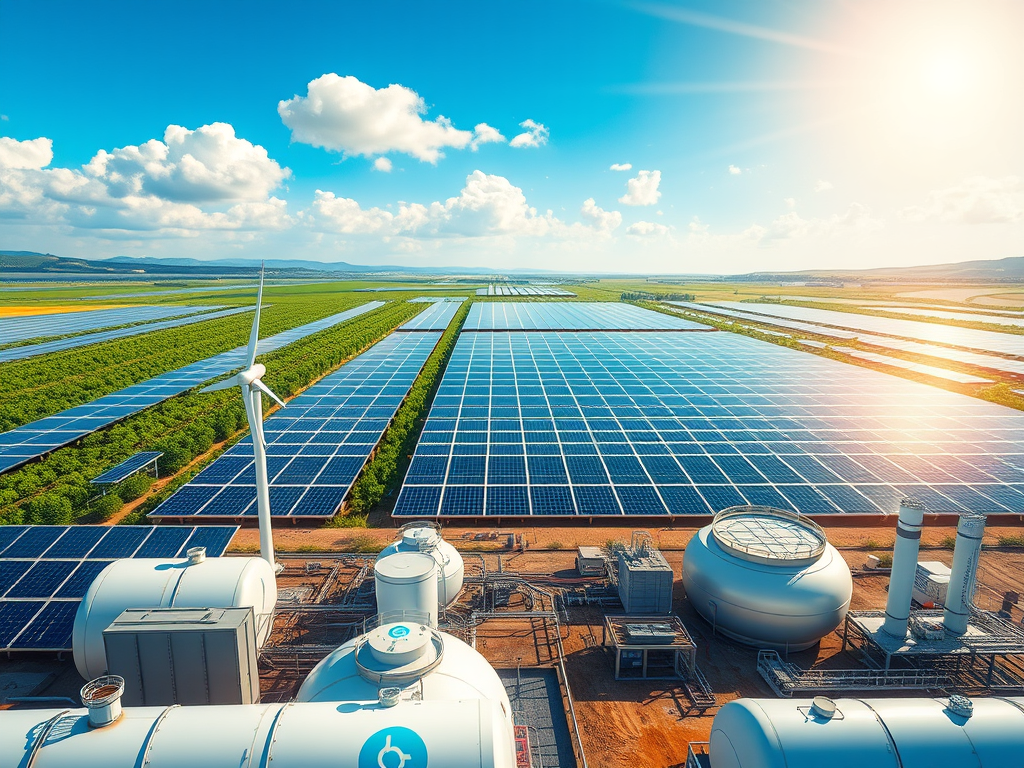
CATEGORY: Future Tech & Innovation | Feereet.com
Europe is making a trillion-euro bet on a gas you cannot see, smell in its pure form, or currently buy at any filling station near you. Green hydrogen is the EU’s most ambitious clean energy gamble, and in 2026 the infrastructure, the politics, and the industrial logic are all converging in ways that are starting to make the bet look less like wishful thinking and more like genuine strategy.
What Green Hydrogen Actually Is
Hydrogen is the most abundant element in the universe but almost none of it exists freely on Earth. It is always bonded to something else, water being the most relevant example. To get usable hydrogen you have to split it from those bonds, and the way you do that splitting determines whether the result is clean or not.
Green hydrogen is produced using electrolysis (passing an electrical current through water to separate hydrogen from oxygen) powered entirely by renewable energy like wind or solar. The only byproduct is oxygen. When the resulting hydrogen is later used as fuel, the only emission is water vapour. The full cycle produces essentially zero carbon dioxide.
This matters because hydrogen can do things that batteries currently cannot. It can store energy for months rather than hours. It can power industrial processes like steel production and chemical manufacturing that are extremely difficult to electrify directly. It can fuel ships and aircraft over distances that current battery technology cannot cover. For the parts of the European economy that cannot simply plug into a grid, green hydrogen is the most credible decarbonisation pathway available.
Three European Investments Defining the Race
Germany has committed more public funding to hydrogen than any other EU member state, with a national hydrogen strategy allocating billions of euros to production, infrastructure, and industrial application. Thyssenkrupp, one of Germany’s largest steel producers, has been piloting hydrogen-based steel production (replacing coal with hydrogen in the steelmaking process) at its Duisburg plant in what is one of the world’s most significant industrial decarbonisation tests.
The results from Duisburg matter globally because steel production accounts for roughly 8% of global CO2 emissions. If hydrogen-based steel becomes economically viable at scale, it removes one of the hardest-to-decarbonise sectors from the emissions equation. Germany is betting that its industrial base will be the laboratory where this transition is proven.
Spain and Portugal have emerged as the EU’s most promising green hydrogen production zones, largely because of their exceptional solar resources. The H2Med pipeline project, connecting the Iberian Peninsula to France and then onward to Germany, is designed to carry green hydrogen produced from Spanish and Portuguese solar directly to industrial consumers in Central Europe. If completed as planned, it would create the first dedicated hydrogen pipeline corridor in the EU.
France has invested heavily in hydrogen through its national low-carbon hydrogen programme, with Air Liquide (one of the world’s largest industrial gas companies, headquartered in Paris) positioning itself as a core infrastructure provider for hydrogen production, storage, and distribution across Europe.
The Baltic Dimension: Small Countries, Real Stakes
For Latvia, Estonia, and Lithuania, the hydrogen economy presents a specific opportunity connected to their rapid expansion of Baltic offshore wind capacity. The Baltic Sea is emerging as one of Europe’s richest offshore wind zones, with major projects across all three countries progressing in 2026. Excess wind energy that cannot be absorbed by the grid in real time can be converted into green hydrogen through electrolysis and either stored, exported, or used locally.
Estonia has been examining hydrogen as a complement to its energy transition, and Baltic energy interconnection projects are increasingly designed with hydrogen compatibility in mind. For a region that was heavily dependent on Russian energy before 2022 and has since been accelerating its energy independence, green hydrogen is not just a climate story. It is a geopolitical one.
Europe vs. the US and Japan: Different Approaches to the Same Problem
The United States responded to Europe’s hydrogen ambitions with the Inflation Reduction Act, which included substantial subsidies for clean hydrogen production that drew criticism from European governments concerned about competitive distortions. American hydrogen strategy is heavily private-sector driven and subsidy-intensive, creating momentum but also creating regulatory uncertainty as policy changes with administrations.
Japan has been the most hydrogen-committed major economy for the longest time, investing in hydrogen fuel cell vehicles and industrial hydrogen use for decades before European interest accelerated. Japanese companies including Toyota and Kawasaki have built significant hydrogen technology expertise. Europe’s advantage over Japan is the scale of its renewable energy resource and the size of its single market for industrial hydrogen demand.
The Honest Challenges
Green hydrogen faces real obstacles that honest analysis requires acknowledging. Production costs remain significantly higher than fossil fuel alternatives in most applications. The infrastructure for transporting and storing hydrogen at scale is mostly unbuilt. Electrolysis equipment requires rare materials with their own supply chain vulnerabilities.
The EU Hydrogen Bank, launched to bridge the gap between current costs and commercial viability through auction-based subsidies, represents the EU’s acknowledgement that the market alone will not build this infrastructure fast enough. Whether the subsidy bridge is wide enough and long enough to carry European hydrogen to commercial viability before political patience runs out is the central question of the next decade.
💬 Here is the question worth thinking about: Europe is betting significant public money on green hydrogen reaching cost competitiveness within a decade. Given that previous clean energy predictions have often been more optimistic than reality justified, how much confidence should citizens and businesses place in hydrogen as a core pillar of the European energy transition? Tell us in the comments.
#GreenHydrogen #EuropeanEnergy #CleanEnergy #HydrogenEconomy #EUGreenDeal
Leave a Reply