
We’ve all seen the movies where the future is full of floating holographic billboards and silver jumpsuits. But in reality, the future doesn’t usually arrive with a fanfare. It arrives as a “feature update.” It starts as an expensive gadget for early adopters and, almost overnight, becomes something we feel annoyed about if it doesn’t work perfectly.
Right now, we are crossing the threshold for several technologies that previously felt like science fiction. They are shedding their “futuristic” labels and becoming part of the boring, beautiful background of our daily lives. Here are the shifts that will feel ordinary much sooner than you expect.
1. Agentic AI: The End of the Search Bar
For the last decade, our relationship with technology has been “request and response.” You type a keyword into a search bar, you get a list of links, and you do the work of clicking and synthesizing.
We are moving into the era of Agentic AI. Instead of a tool that gives you information, an “agent” is a tool that takes an action.
- The Ordinary Shift: Soon, you won’t “search” for a flight. you’ll tell your device, “I need to be in Tokyo for a wedding next month; book me a flight with extra legroom and a hotel near the park that has a gym.”
- The Result: The AI doesn’t just show you options; it navigates the websites, handles the payment, and adds it to your calendar. This will quickly feel as normal as using a spell-checker.
2. Ambient Sensing: The House That “Knows”
The “Smart Home” has long been a frustration of apps that don’t connect and light bulbs that require firmware updates. But a quiet transition is happening toward Ambient Intelligence.
Using mmWave radar and low-power sensors, our environments are beginning to detect presence and intent without cameras.
- The Ordinary Shift: Your lights won’t just turn on when you walk in; they will adjust their warmth because the house “knows” you’ve been staring at a screen for four hours. Your thermostat will adjust because it senses your respiratory rate has dropped, signaling you’ve fallen asleep on the couch.
- The Result: We will stop “managing” our homes. We will simply exist in spaces that adapt to our biological needs in real-time, making the idea of a manual light switch feel like a relic of the past.
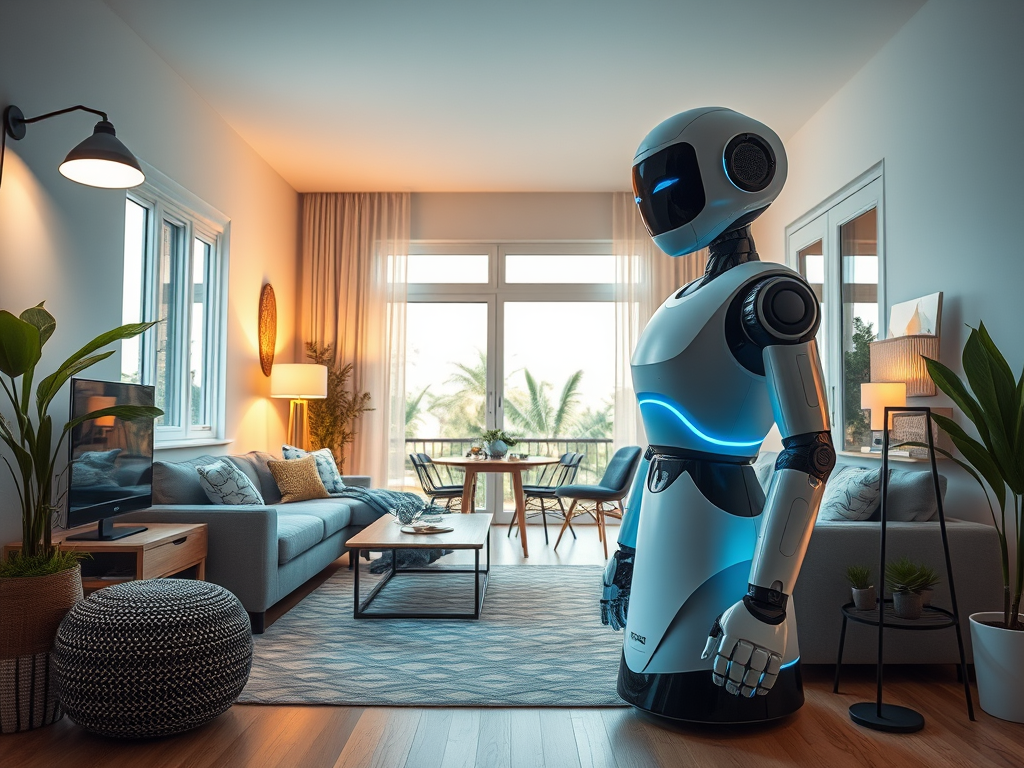
3. Physical AI: Robots with “Jobs,” Not Personalities
We’ve spent a long time waiting for a Rosie the Robot to talk to us while she vacuums. Instead, we are getting Physical AI intelligence embedded into functional forms.
We are seeing a surge in specialized robotics that solve “friction” rather than trying to be human.
- The Ordinary Shift: From “trifold” mobile devices that transform into workstations to autonomous delivery pods that bring your groceries to the curb, robotics is becoming a logistics layer. In professional settings, AI is moving into the “middle office,” automating the paperwork of insurance claims or legal underwriting.
- The Result: You won’t be amazed when a robot delivers your coffee or when your car drives itself through a kilometers-long production route. You’ll just be glad you don’t have to do it yourself.
4. On-Device Sovereignty: The Private Brain
For years, the trade-off for “smart” tech was “cloud” privacy. If you wanted the AI to be smart, you had to send your data to a giant server.
The new standard is On-Device AI. Modern processors are now powerful enough to run massive language models locally.
- The Ordinary Shift: Your voice commands, your health data, and your private messages are analyzed entirely on your own hardware.
- The Result: This makes technology faster (no lag) and more reliable (works offline). Privacy isn’t a “setting” you toggle; it’s the default architecture. We will soon expect our devices to be “smart” without ever needing to “call home.”
5. Tokenized Ownership: The Digital Receipt
We are moving away from the era of “renting” our digital lives. Whether it’s a concert ticket, a professional certification, or a fractional piece of art, Blockchain-backed tokenization is becoming the invisible backend for ownership.
- The Ordinary Shift: You won’t talk about “Web3” or “NFTs.” You will simply have a digital wallet that holds your car title, your health records, and your loyalty points.
- The Result: Verification becomes instant. You won’t need to wait three days for a bank to “clear” a high-value transfer or for a third party to verify your diploma. Trust becomes a built-in feature of the internet.
Why “Boring” is a Good Thing
The greatest compliment we can pay to a technology is to find it boring. When a tech is “exciting,” it means it’s still broken, expensive, or exclusive. When it becomes ordinary, it means it’s actually working.
The future isn’t a destination we reach; it’s a series of small conveniences that pile up until we can’t imagine living without them. So, the next time your phone anticipates your next move or your house adjusts to your mood, take a second to realize: the “future” just became your Monday morning.
Leave a Reply