
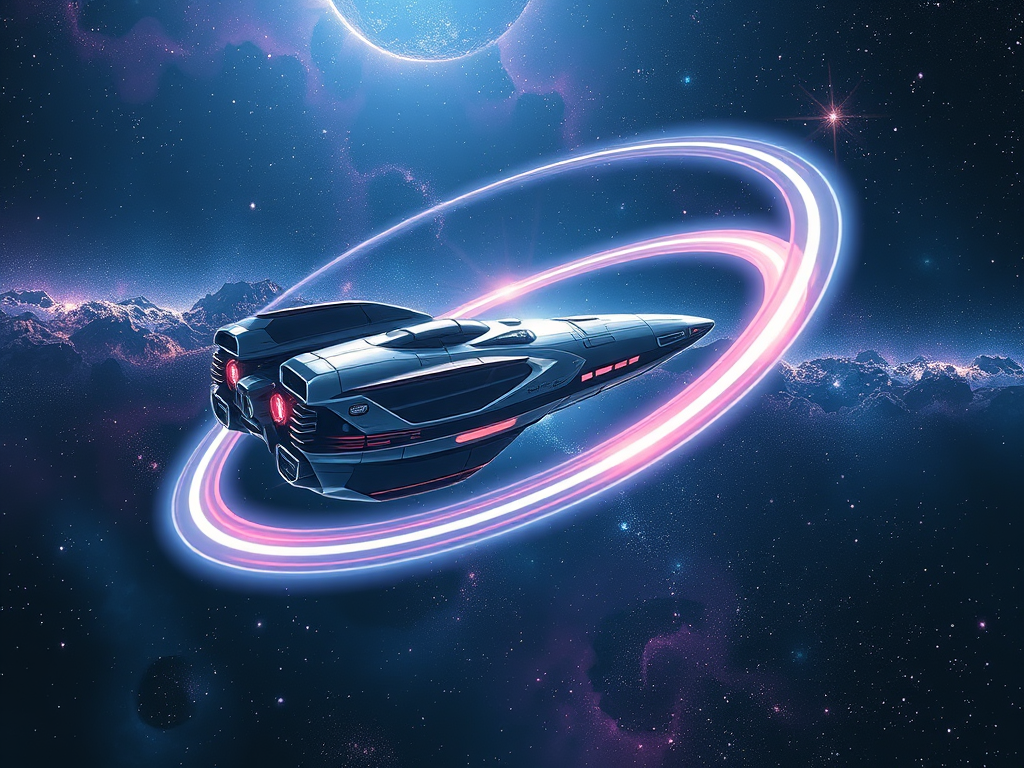
For over half a century, chemical rockets have been our primary ticket to the cosmos. These incredible machines have propelled us to the Moon, sent probes across our solar system, and established a permanent human presence in Earth orbit. But the dream of truly interstellar travel, journeys to distant stars and the exploration of exoplanets, requires us to think far beyond the limitations of conventional propulsion. The future of space travel hinges on groundbreaking theoretical concepts and radical technological advancements that could redefine our understanding of physics and our place in the universe.
This journey into the future of space travel will explore some of the most tantalizing possibilities: warp drives that could bend spacetime itself, wormholes that might offer shortcuts across vast cosmic distances, and other innovative propulsion systems that could one day make interstellar voyages a reality.
Breaking the Light Barrier: The Promise of Warp Drives
The sheer scale of the universe presents the most significant hurdle to interstellar travel. Even Proxima Centauri, our nearest star system, is over four light-years away. Traveling at conventional rocket speeds, such a journey would take tens of thousands of years, far exceeding human lifespans. This is where the concept of the warp drive enters the picture, igniting the imaginations of scientists and science fiction enthusiasts alike.
The theoretical basis for a warp drive comes from the work of physicist Miguel Alcubierre in 1994. His concept doesn’t involve breaking the speed of light within a local frame of reference, which is forbidden by Einstein’s theory of special relativity. Instead, it proposes a “warp bubble” around a spacecraft. This bubble would contract spacetime in front of the spacecraft, effectively pulling it towards its destination, while simultaneously expanding spacetime behind it, pushing it away from its origin. The spacecraft itself would remain within the bubble in normal spacetime and would not experience the effects of relativistic time dilation.
The Challenges Ahead:
While mathematically intriguing, the Alcubierre drive faces immense practical challenges:
- Exotic Matter: The equations require the existence of “exotic matter” with negative mass density, something that has never been observed and whose existence is purely theoretical. Creating and harnessing such matter, if it exists, would be a monumental undertaking.
- Energy Requirements: The amount of energy required to warp spacetime, even a small amount, is astronomical—likely exceeding the total energy output of a star. While subsequent calculations have reduced this theoretical requirement, it still remains far beyond our current technological capabilities.
- Stability and Control: Maintaining the warp bubble and navigating with precision would present enormous engineering hurdles.
Despite these challenges, the warp drive remains a compelling concept, pushing the boundaries of theoretical physics and inspiring ongoing research into the nature of spacetime.
Shortcuts Through Spacetime: The Enigma of Wormholes
Another fascinating possibility for interstellar travel lies in the hypothetical existence of wormholes, also known as Einstein-Rosen bridges. These are theoretical tunnels through spacetime that could connect two distant points in the universe, potentially allowing for faster-than-light travel.
The concept arises from Einstein’s theory of general relativity, which describes gravity as a curvature of spacetime. Just as a sheet of paper can be folded to bring two distant points closer, spacetime itself could theoretically be warped and folded to create a shortcut.
The Obstacles to Traversable Wormholes:
While the mathematics allows for the possibility of wormholes, making one traversable for humans presents significant problems:
- Exotic Matter (Again): Similar to warp drives, maintaining a stable wormhole is believed to require exotic matter with negative mass density to prevent it from collapsing.
- Formation: How such a tunnel through spacetime could naturally form, or how we could artificially create one, is entirely unknown. The energy densities involved would likely be extreme, possibly requiring manipulation of gravity on a scale far beyond our current understanding.
- Stability: Even if a wormhole could be formed, its stability would be a major concern. Quantum effects might cause it to collapse almost instantly.
Despite these formidable hurdles, the allure of a cosmic shortcut remains strong, driving theoretical research and inspiring creative solutions.
Beyond Spacetime Manipulation: Alternative Propulsion Systems
While warp drives and wormholes capture the imagination, other, more near-term (though still highly advanced) propulsion technologies are being explored that could dramatically improve our ability to travel within and beyond our solar system:
- Ion Propulsion: Already in use for deep-space probes, ion thrusters use electric fields to accelerate charged particles (ions), producing a very small but continuous thrust. They are far more fuel-efficient than chemical rockets but provide much lower acceleration, making them suitable for long-duration missions. Future advancements could lead to more powerful and efficient ion drives.
- Nuclear Propulsion: Concepts like nuclear thermal propulsion (NTP) and nuclear electric propulsion (NEP) offer the potential for significantly higher thrust and efficiency compared to chemical rockets. NTP uses a nuclear reactor to heat propellant, while NEP uses a reactor to generate electricity for ion or other electric thrusters. These technologies face challenges related to safety and public perception but could be crucial for faster interplanetary travel.
- Fusion Propulsion: Harnessing the power of nuclear fusion, the same process that powers the Sun, could provide immense amounts of energy for propulsion. Fusion rockets could potentially achieve very high exhaust velocities, leading to faster travel times and greater mission capabilities. However, controlled nuclear fusion remains a significant technological challenge.
- Photonic Propulsion (Lightsails): Using the pressure of sunlight or laser beams to propel spacecraft equipped with large, reflective sails offers a propellant-free method of propulsion. While acceleration is slow, over long distances, lightsails could potentially reach significant speeds.
Conclusion: A Future Among the Stars Awaits
The future of space travel beyond our solar system is a landscape of incredible possibilities and daunting challenges. While warp drives and wormholes remain firmly in the realm of theoretical physics, ongoing research into advanced propulsion systems offers a more tangible path towards interstellar ambitions. The journey will undoubtedly be long and filled with unforeseen obstacles, but the human drive to explore the unknown is a powerful force. As our understanding of the universe expands and our technological capabilities advance, the dream of reaching other stars may one day become a breathtaking reality.
Share your thoughts! Which of these future space travel technologies excites you the most? Let us know in the comments below. If you enjoyed this cosmic exploration, please share this post and follow us for more insights into the cutting edge of science and technology!
#SpaceTravel #WarpDrive #Wormholes #Interstellar #FutureTech
Leave a Reply