
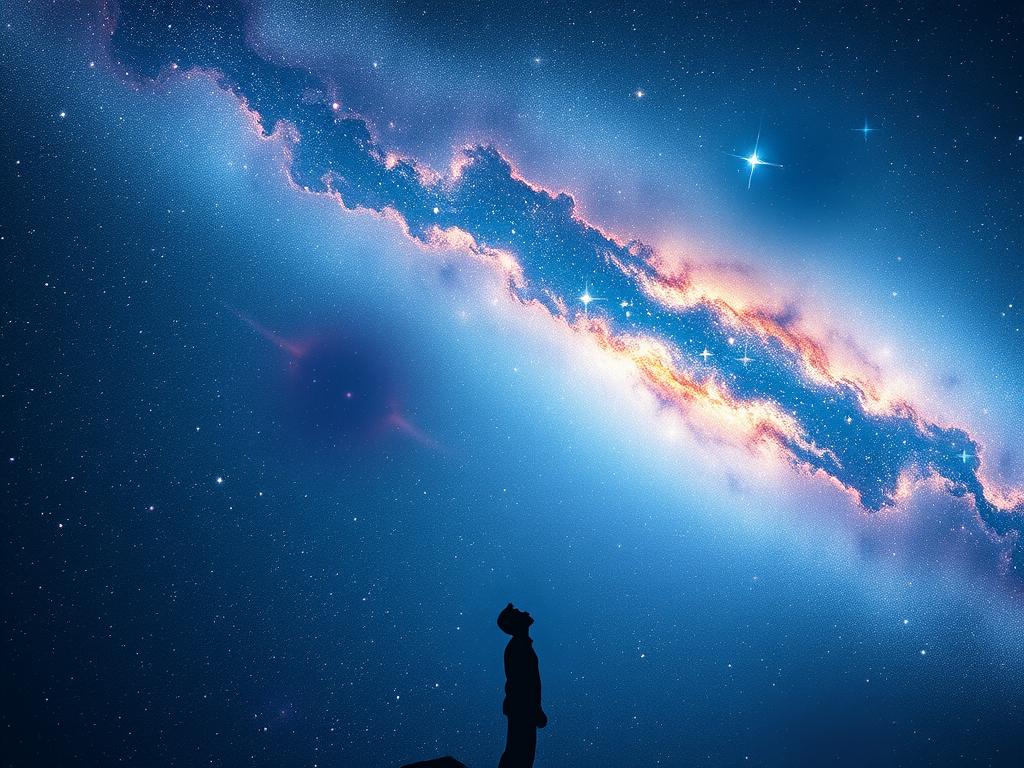
For thousands of years, humanity has looked up at the stars and asked the same two questions: What is out there? and What does it have to do with me? For much of our history, the stars were navigators, gods, or distant mysteries. But today, through the lens of modern telescopes and the data from interplanetary probes, we are realizing that the universe isn’t just a place we inhabit. It is the story of our origin, and studying it is the ultimate exercise in self-discovery.
Astronomy often gets a reputation for making people feel “small.” When we see images of galaxies containing hundreds of billions of suns, or nebulae spanning light-years across, the scale is indeed staggering. Yet, the deeper we look into the cosmic dark, the more we learn that our “smallness” isn’t a sign of insignificance—it’s a testament to how extraordinary it is that we are here at all.
The Stardust Connection: Our Biological Heritage
One of the most profound realizations of modern science is that the boundary between the “heavens” and the “earth” is an illusion. We are literally made of the universe. Every carbon atom in your DNA, the calcium in your teeth, and the iron in your blood was forged inside the heart of a dying star billions of miles away.
When a massive star reaches the end of its life and explodes in a supernova, it scatters these heavy elements into space. Over eons, gravity pulls that “stardust” together to form new planets and, eventually, life. Studying the chemistry of distant nebulae isn’t just about understanding gas and dust; it’s about tracing our own lineage back to the furnace of the stars. We are the universe’s way of experiencing itself.
The “Overview Effect” and Global Unity
Astronauts often report a cognitive shift known as the Overview Effect. Looking down at Earth from orbit, the political borders that dominate our headlines vanish. The atmosphere appears as a thin, fragile “onion skin” protecting everything we love from the harsh vacuum of space.
This perspective teaches us a lesson in radical empathy. In the vastness of the cosmos, Earth is a “Pale Blue Dot”—a tiny oasis of life in a silent desert. Studying the harsh environments of our neighbors, like the acid clouds of Venus or the frozen deserts of Mars, reinforces how precious and rare our home is. Astronomy doesn’t just teach us about space; it teaches us to be better stewards of the only planet we’ve ever known. It reminds us that we are one crew on one very small ship.
Time Travel Without a Machine
One of the “superpowers” of astronomy is the ability to look back in time. Because light takes time to travel across the vast distances of space, when we look at a star that is a thousand light-years away, we aren’t seeing it as it is now. We are seeing it as it was a thousand years ago.
The latest deep-space observatories allow us to peer back nearly to the beginning of time itself. By observing the “toddler” phase of our universe, we see the raw materials of reality being assembled. This teaches us about Patience and Process. We learn that the beauty and complexity we see today required billions of years of slow, steady evolution. It places our frantic, fast-paced modern lives into a much calmer, cosmic context.
The Humility of the “Great Silence”
As we search for exoplanets—planets orbiting other stars—we are finding that the universe is likely teeming with worlds. We have identified thousands of planets, some in the “Goldilocks Zone” where liquid water could exist. And yet, the “Great Silence” remains. We have yet to find definitive proof of another civilization.
This silence offers a powerful lesson in Humility and Responsibility. If we are currently the only ones capable of observing and understanding the universe, we have a profound duty to survive. Whether we are alone or just one of many, the fact that we have the curiosity and the technology to ask the question makes our species a vital part of the cosmic story. Our ability to wonder is the universe’s greatest achievement.
Cultivating Cosmic Perspective in Daily Life
You don’t need a multi-billion dollar telescope to learn from the universe. You can bring a “Cosmic Perspective” into your daily life by embracing a few simple mindset shifts:
- Embrace Curiosity: Never stop asking “Why?” The same curiosity that drives an astrophysicist to study black holes can drive you to understand your own world better.
- Practice Gratitude: Every time you breathe, remember that the oxygen was provided by a complex planetary cycle that doesn’t exist anywhere else nearby.
- Zoom Out: When daily stresses feel overwhelming, look up at the night sky. Remember that your problems exist on a tiny grain of sand in a vast, beautiful, and largely peaceful ocean.
The universe is not an empty, cold place; it is a mirror. The more we learn about the stars, the more we understand the intricate, beautiful, and fragile nature of our own existence. We are travelers on a magnificent journey, and the stars are the light that shows us the way home.
#SpaceExploration #AstronomyLove #CosmicPerspective #ScienceAndSpirit #PaleBlueDot
Disclaimer: This article is intended for educational and inspirational purposes, reflecting current scientific understandings and philosophical interpretations within the fields of astronomy and cosmology. Space science is a rapidly evolving field, and new discoveries may refine or alter these perspectives.
Leave a Reply