
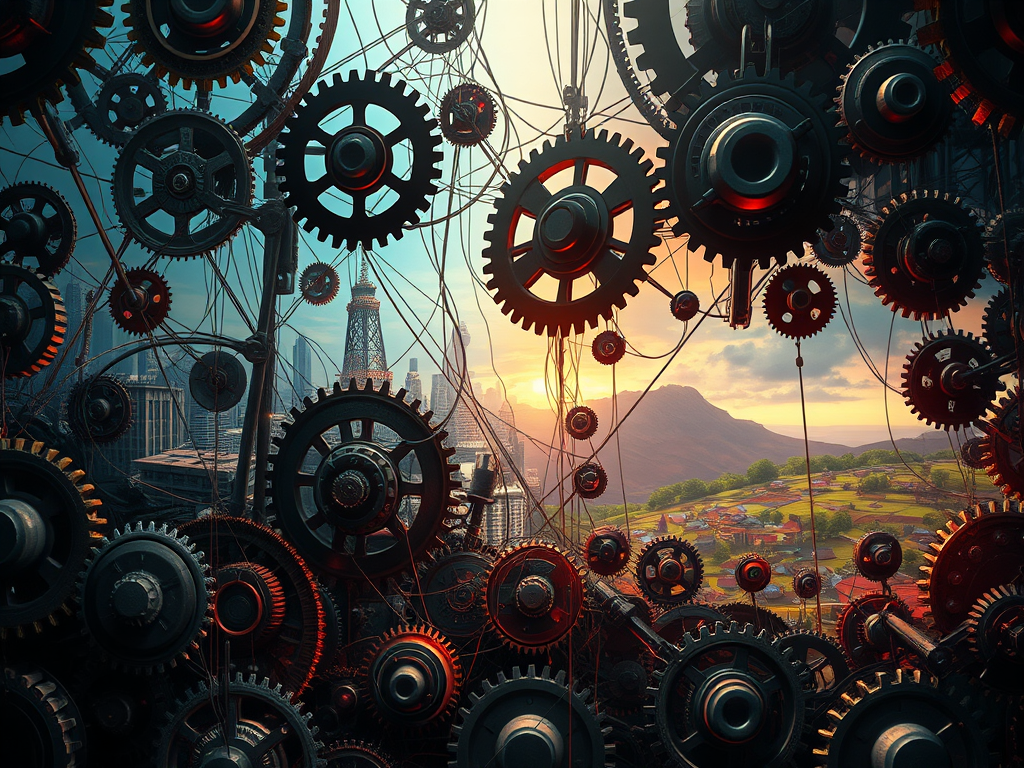
There is a quiet frustration many people carry today. It appears during elections, public debates, economic shocks, climate events, and even personal decisions. We watch intelligent individuals argue with confidence while missing something obvious. We see institutions react too late, or in ways that make problems worse. We sense that the world is becoming more complex, but our thinking is not.
Most people do not say this out loud. They simply feel exhausted.
The truth is uncomfortable. Humans are not naturally built to think systemically. We are built to survive immediate threats, not invisible interconnections.
For most of history, this worked well. If danger came, it had a face. A predator. A rival group. A sudden shortage. The cause and the effect were close in time. Action led to visible outcomes. The mind learned through feedback.
But modern crises do not behave this way. They are layered. Slow. Distributed. Often invisible until they reach a tipping point.
This is why people struggle to understand inflation, supply chain breakdowns, climate instability, or technological disruption. The causes do not look like the consequences. The feedback loops are delayed. The signals are noisy. By the time a pattern becomes clear, it is already too late to respond easily.
So the brain defaults to what it knows.
It searches for simple stories.
Who is to blame. What event caused this. Which decision fixed or broke everything. This instinct is not stupidity. It is a survival mechanism. Clear narratives reduce anxiety. Complexity increases it.
This is why conspiracy thinking spreads during crises. Not because people reject reason, but because systemic explanations often feel emotionally empty. They lack villains and heroes. They demand patience. They offer no immediate relief.
In contrast, simple narratives offer certainty.
Technology is amplifying this tension. Algorithms reward clarity and emotional intensity. They compress complexity into shareable fragments. They reward speed over reflection. This does not just shape what people see. It shapes how they think.
The result is a culture that reacts quickly but understands slowly.
We see this in public health responses. In financial markets. In geopolitical conflicts. In how societies interpret artificial intelligence. The debate rarely centers on systems. It focuses on events.
A new tool appears. A crisis erupts. A failure becomes visible. The response follows the last visible shock, not the underlying structure.
This creates a dangerous illusion of control.
We feel active because we are responding. But we are often reinforcing the system that produced the crisis in the first place. Short term fixes stabilize symptoms while deep patterns grow stronger.
People sense this pattern even if they cannot describe it. It explains the growing distrust toward experts and institutions. When solutions fail repeatedly, confidence erodes. Not because expertise is useless, but because many solutions are not systemic.
The deeper issue is cognitive.
Systemic thinking requires accepting uncertainty. It requires holding multiple causes at once. It requires resisting the urge to close the story too early. This feels uncomfortable. It feels incomplete. It feels weak.
But it is the only way to navigate complex environments.
The future will reward those who can tolerate this discomfort.
Education systems are beginning to change, but slowly. Organizations experiment with scenario planning, network analysis, and adaptive strategies. Yet the emotional challenge remains. Humans crave closure.
The most important shift will not be technical. It will be psychological.
We will need to learn how to live without immediate answers. How to make decisions without perfect information. How to see feedback loops instead of isolated events. How to recognize that in complex systems, every solution changes the environment.
This also applies to personal life.
Health, relationships, career decisions, financial stability all operate within systems. Habits compound. Small changes cascade. Delayed consequences shape the future more than dramatic moments.
This realization can be unsettling. It removes the comfort of single turning points. It replaces it with ongoing responsibility.
But it also offers freedom.
If crises are systemic, they are also adaptable. They can be reshaped through coordinated shifts rather than heroic interventions. Progress becomes quieter, less visible, but more durable.
We are moving from a culture of reaction to a culture of navigation.
The transition will feel slow. Many will resist it. Some will exploit the confusion. But gradually, a new kind of thinking will emerge. One that accepts complexity without surrendering agency.
The discomfort people feel today is not a sign of decline. It is a sign of cognitive evolution under pressure.
The world is not becoming impossible to understand. It is demanding a different way of understanding.
The question is whether we will learn before the next crisis forces us to.
Disclaimer: This article presents forward looking reflections on human cognition and complex systems. It is intended for educational and informational purposes only.
#SystemicThinking #FutureMindset #HumanBehavior #ComplexWorld #Feereet
Leave a Reply