
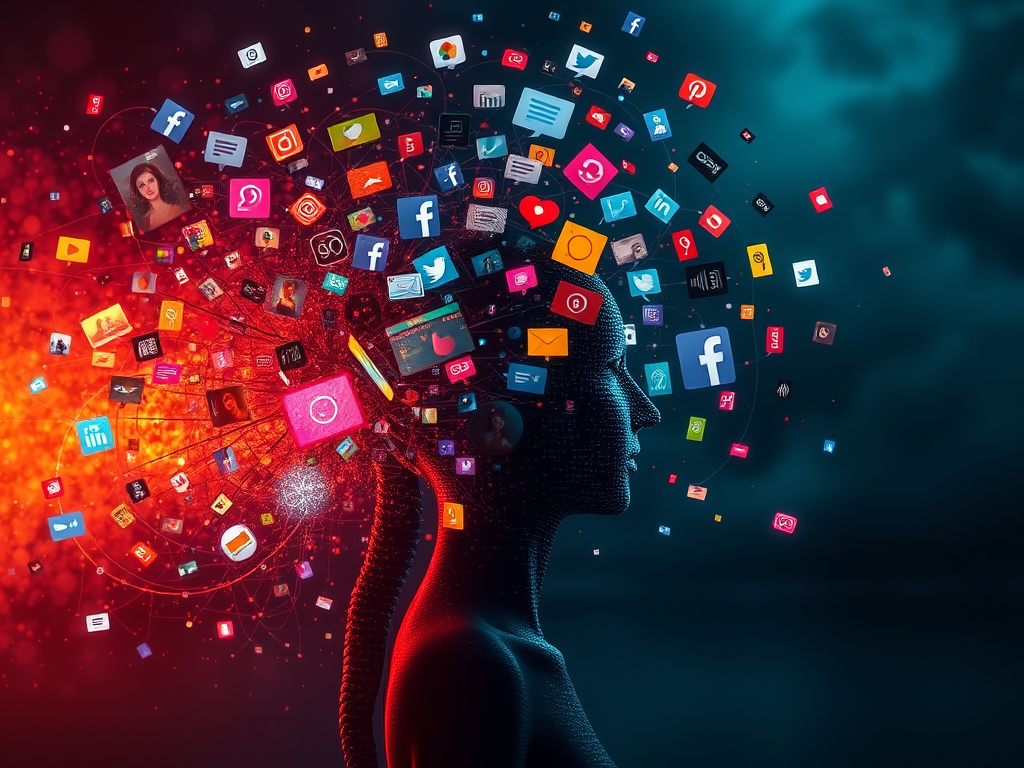
We are currently conducting the largest psychological experiment in history, and we are doing it without a control group.
For the vast majority of human existence, information was scarce, localized, and finite. If you wanted to learn something, you sought it out. If you wanted to see something, you had to be there. When a story ended, the book was closed. When the sun went down, the world went quiet. There was a natural “stop” to the flow of the world.
Today, we have replaced the horizon with the “Infinite Feed.” We have built a digital architecture that specifically lacks a bottom, a boundary, or a pause. We act as if our brains can handle a never-ending stream of high-velocity stimuli, but our biology tells a much more unsettling story.
We aren’t just “distracted.” We are experiencing a fundamental physiological mismatch between our ancient hardware and our modern environment.
The Exhaustion of the Orienting Reflex
At our core, we are survival machines. One of our most basic biological tools is the Orienting Reflex. This is the brain’s “What is that?” response. Every time something moves in your peripheral vision, every time a new color flashes, or a notification pings, your brain reflexively shifts its attention to assess if that new stimulus is a threat or an opportunity.
In the wild, this happened occasionally. On a smartphone, it happens every three seconds. When you scroll an infinite feed, you are triggering your orienting reflex thousands of times an hour. This doesn’t just make you “busy”; it creates a state of Neural Fatigue. You are burning through your brain’s limited supply of glucose and oxygen just to process the sheer volume of “newness,” leaving nothing left for deep thought, empathy, or long-term planning.
The Dopamine Loop and the Death of Satiety
The infinite feed exploits a specific glitch in our reward system. We were designed to seek out “novelty” because novelty usually led to resources—food, water, or social status. This search is driven by Dopamine, the chemical of “more.”
Dopamine is not about pleasure; it is about anticipation. It is the itch, not the scratch.
In a natural environment, the search ends. You find the berry bush, you eat, and your brain signals Satiety—a sense of “enough.” But the infinite feed never offers satiety. There is always one more post, one more video, one more headline. We are keeping our brains in a permanent state of craving, which is why you can scroll for two hours and feel both “full” of information and completely empty of satisfaction.
The Fragmentation of the Self
We often think of our “self” as a stable thing, but it is actually a narrative constructed by our memory. To form a cohesive sense of who we are, we need “processing time”—moments of boredom and reflection where the brain can move information from short-term to long-term memory.
The infinite feed denies us this time. By providing a continuous stream of “elsewhere,” it prevents us from being “here.” When we occupy every spare second with a screen, we are effectively preventing our brains from doing the background work of self-integration.
This is the source of that modern, phantom discomfort: the feeling that your life is a series of disconnected snapshots rather than a continuous story. You are becoming a spectator of a thousand lives while losing the thread of your own.
The Survival of the Still
The future is often framed as a race to see who can process the most information the fastest. But as information becomes infinitely available and automated, the true competitive advantage will shift toward the “Biological Outliers”—those who can still control their own attention.
If you cannot sit in a room for thirty minutes without a digital “hit,” you are no longer the operator of your own brain; you are a component in someone else’s data-extraction model.
Your Mental Framework: This week, identify the “Natural Stops” in your day—the commute, the elevator ride, the queue at the cafe. Notice the physical pull, the literal itch in your hand to reach for the phone. Don’t fight the urge; just observe it.
The goal isn’t to “delete the internet.” It is to reintroduce the concept of Enough. The most revolutionary thing you can do in an infinite world is to decide where your world ends.
Disclaimer: This article is for informational and educational purposes only. The neurological and biological insights provided are intended to foster critical reflection and do not constitute professional medical, psychological, or psychiatric advice. Always consult with a qualified health professional regarding issues of mental health or addiction.
#FutureLiteracy #BrainBiology #AttentionEconomy #DigitalWellness #NeuroscienceOfTech
Leave a Reply