
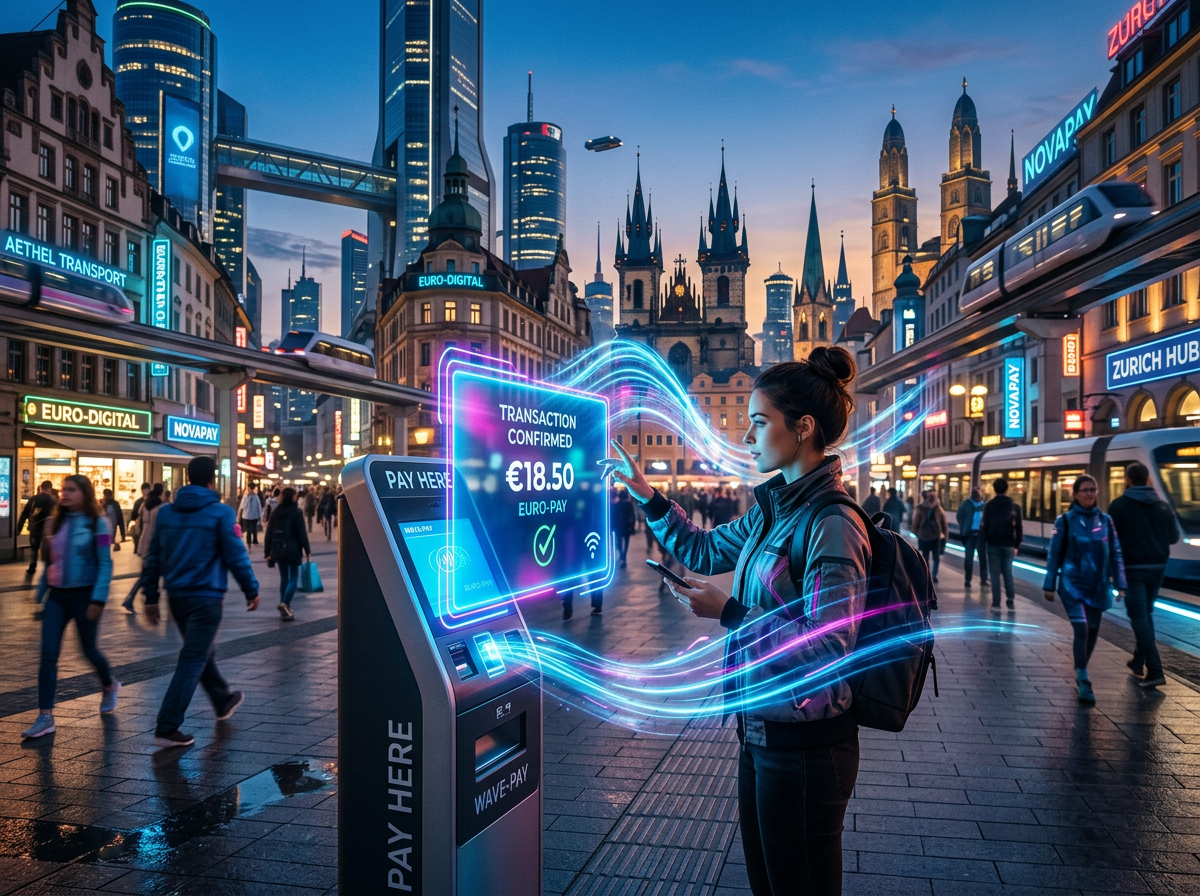
Imagine a world where your digital payments are as private and reliable as the physical coins in your pocket, but as convenient as a smartphone tap. No, we aren’t talking about a new crypto-token or a private banking app. We are talking about the Digital Euro, the official digital currency currently being prepared by the European Central Bank (ECB) to modernize how we pay from Lisbon to Riga.
What is a CBDC?
To understand the Digital Euro, we first need to define a CBDC (Central Bank Digital Currency). Unlike the money in your commercial bank account, which is a private liability of that bank, a CBDC is “public money” issued directly by the central bank. It is the electronic equivalent of a physical five-euro note.
In 2026, the project has entered a critical stage. While the ECB began its “preparation phase” back in late 2023, we are now in the midst of finalizing the technical standards and legislative framework. The goal is to create a digital payment method that works everywhere in the euro area, for everyone, at any time.
Why Do We Need It?
The Digital Euro isn’t here to replace cash; the ECB has been very clear that banknotes will remain available. Instead, it is about Strategic Autonomy. Currently, a massive portion of European digital payments relies on non-European providers like Visa, Mastercard, or PayPal. If those systems ever faced a major outage or geopolitical restriction, Europe’s economy could grind to a halt.
By launching a sovereign digital currency, the EU ensures we have a back-up system that is “Made in Europe.” For a small business in Latvia or a freelancer in Germany, this means having a payment method that is universally accepted across all 27 member states, potentially reducing the high fees often associated with international card schemes.
Privacy and the “Offline” Advantage
One of the most exciting features of the Digital Euro is its Offline Functionality. Most current digital payments require an internet connection to verify funds. The Digital Euro is being designed to work even when you have no signal, using secure hardware in your phone to “store” value locally, much like a physical wallet.
When you pay offline, your privacy is “cash-like.” The Eurosystem (the ECB and national central banks) would not see who you are paying or what you are buying. Even for online payments, the system is built with a “Privacy-by-Design” approach, ensuring that the central bank cannot identify individual users based on their transaction history.
The “Waterfall” and Holding Limits
To prevent people from moving all their savings out of traditional banks (which could cause financial instability), the ECB is introducing a Holding Limit. Current proposals suggest a cap of around 3,000 to 4,000 euros per person.
But what if you want to buy something that costs 5,000 euros? This is where the Waterfall Approach comes in. Your digital euro wallet can be linked to your regular bank account. If you make a purchase that exceeds your digital euro balance, the system automatically “pulls” the remaining funds from your bank account to complete the transaction instantly. Conversely, if someone sends you money that puts you over the limit, the excess flows back into your bank account.
Europe vs. the World
The EU is taking a very different path compared to other global powers.
- China (e-CNY): The digital yuan is already widely used but has faced criticism over state surveillance and a lack of privacy.
- United States: The US Federal Reserve remains in a “wait and see” mode, prioritizing private-sector innovations like FedNow (an instant payment rail) rather than a retail digital dollar.
- Europe: We are aiming for the middle ground, a public digital currency that prioritizes privacy and legal certainty over total state control or purely private profit.
A New Era for Baltic Digital Pioneers
For citizens in Estonia, Latvia, and Lithuania, the Digital Euro feels like a natural next step. Our region is already among the most digitalized in the world. The transition to a digital euro will likely be seamless here, as our banking infrastructures are already heavily modernized. In 2026, many Baltic banks are already participating in the ECB’s selection process for Payment Service Providers (PSPs) to test the first beta versions of the system.
As we look toward a potential full launch later this decade, the Digital Euro represents a promise: that in a digital world, our money remains a public good that belongs to everyone.
If the Digital Euro offered the same privacy as cash but the convenience of Apple Pay, would you use it as your primary way to pay, or do you still trust your traditional bank more?
Learn more about the Digital Euro:
- ECB Official Digital Euro Project Hub
- European Commission’s Legislative Proposal
- Central Bank of Ireland: Beginner’s FAQ
#DigitalEuro #CBDC #FutureOfMoney #EUEconomy #FinTech2026 #PaymentInnovation #DigitalSovereignty
Leave a Reply