
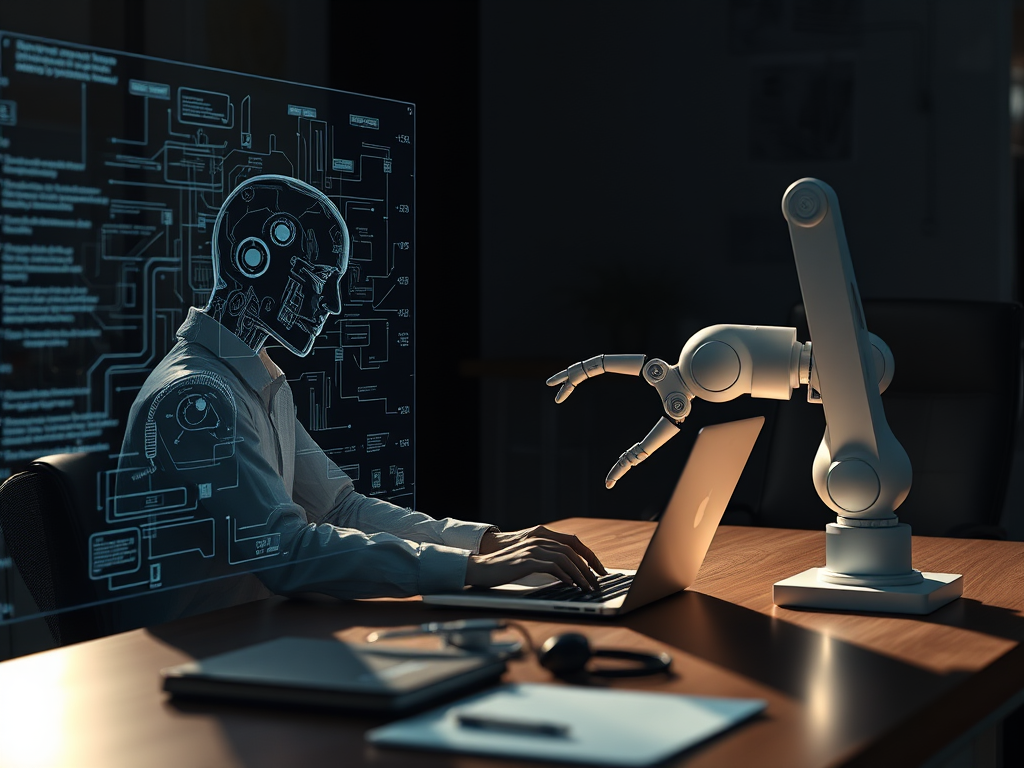
For decades, the narrative of automation was one of replacement. We envisioned a binary event, a “Job” existed, a “Robot” arrived, and the human departed. We braced for a sudden vacancy, a world of empty desks and silent factories.
But the reality of the 2020s is far more subtle and, in many ways, more exhausting. Work hasn’t disappeared, it has transformed into a continuous, high-stakes negotiation between human intent and machine execution.
We are no longer just “doing” our jobs. We are managing the parameters of an intelligence that is faster than us, but lacks our context. The quiet dread you feel at your laptop isn’t the fear of being fired, it’s the fatigue of being a “Human-in-the-Loop” the person responsible for the mistakes of a system you don’t fully control.
The Shift from Creation to Curation
In the traditional model of work, the human was the engine. You performed the research, you wrote the draft, you calculated the spreadsheet. You owned the process from the first spark to the final delivery.
Today, the machine is the engine, and the human has been promoted, or perhaps demoted, to the role of Governor. Whether you are a lawyer using predictive text to draft a brief, or a coder using a co-pilot to generate blocks of syntax, you are moving away from creation and toward curation.
The negotiation is constant: How much of this output do I trust? Where is the hallucination hidden? At what point does my intervention add value, and at what point am I just slowing down the speed of light? When the machine provides 80% of the result for 1% of the effort, the human struggle to provide that remaining 20% starts to feel economically irrational.
The Quantified Manager
As work becomes digital and decentralized, the “Manager” is also being replaced by a system of sensors and incentives. In the world of Web3 and the gig economy, your boss is often an algorithm.
This is the negotiation of the “Digital Contract.” You provide the data, the “Proof of Work”, and the system provides the reward. There is no room for the “soft” variables of human life: the bad morning, the flash of unquantifiable brilliance, the intuitive detour. We are being asked to make ourselves “legible” to the machine, stripping away the nuances of our behavior so that the system can categorize us accurately. We are negotiating away our complexity for the sake of the platform’s efficiency.
The Decentralization of Responsibility
The rise of Web3 and DAOs (Decentralized Autonomous Organizations) was promised as the ultimate liberation, the end of the corporate hierarchy. But it has introduced a new kind of trap, the Diffusion of Accountability.
In a negotiation between a human and a decentralized system, who do you talk to when the system is wrong? When the smart contract executes an error, or the algorithm de-prioritizes your skill, there is no office to visit. We are working for “The Network,” a faceless entity that rewards performance but cannot offer empathy.
The discomfort we feel is the loss of the “Human Buffer.” In the old world, a boss could be reasoned with. In the new world, you don’t reason with the code; you either optimize for it, or you are discarded by it.
The Value of the “Inefficient” Human
If the machine wins the negotiation on speed, accuracy, and volume, what is left for the human to bring to the table?
The future of work belongs to the “Sovereign Negotiator.” This is the person who understands that the machine is a tool for answers, but humans are the only source of questions.
- The machine optimizes; the human directs.
- The machine calculates; the human cares.
- The machine follows the map; the human decides where the destination should be.
The danger is that we spend so much time negotiating with the machine on its terms, trying to be faster, more data-driven, more “optimal” that we forget how to do the things the machine can’t. We are winning the negotiation of efficiency while losing the negotiation of meaning.
Reclaiming the Interface
To stay relevant, we must stop trying to be “Better Machines.” We must become “Deep Humans.”
Your Mental Framework: This week, look at your most frequent work tasks. Ask: “Am I the pilot here, or am I just the safety switch for the autopilot?” Identify the parts of your job that feel “inefficient”, the long conversations, the deep thinking, the ethical agonizing.
Those “inefficiencies” are your only leverage. In a world of automated answers, the person who still knows how to agonize over the truth is the only one who can’t be replaced.
Disclaimer: This article is for informational and educational purposes only. The perspectives on the future of work, Web3, and automation are intended to foster critical foresight and do not constitute professional career, financial, or legal advice.
#FutureOfWork #HumanInTheLoop #AlgorithmicManagement #Web3 #SystemicThought
Leave a Reply