
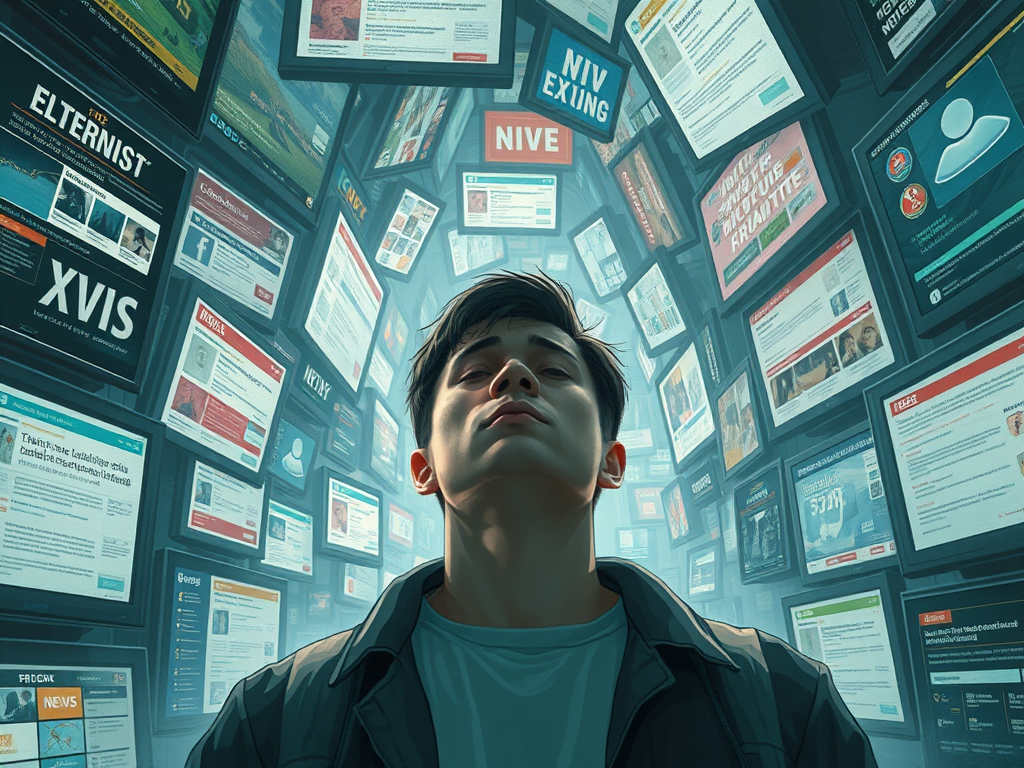
We live in the era of the perpetual refresh.
Our software updates while we sleep. Our news feeds cycle through “breaking” stories every ninety seconds. Our social circles provide a live-streamed ledger of every meal, flight, and fleeting thought. We have cultivated a cultural phobia of the “outdated,” equating being uninformed with being obsolete.
But there is a specific, quiet exhaustion that comes with being perfectly current. It is the fatigue of the surfer who must paddle constantly just to stay in the same place.
The discomfort you feel, that hollow sense of being “full” of information but “empty” of perspective, is the biological tax of the update. We have traded the deep, slow-moving currents of wisdom for the high-velocity spray of the now. We are perfectly updated, yet we have never been more disoriented.
The Tyranny of the Immediate
The psychological cost of being “updated” is the total erosion of Contextual Distance.
To understand something, you need to stand back from it. You need the passage of time to act as a natural filter, separating the signal from the noise. When you are constantly updated, you are standing too close to the elephant to see the animal. You see only the texture of the skin, the immediacy of the movement, the urgency of the moment.
By demanding to know what is happening now, we lose the ability to ask why it is happening. We are treating the world as a series of disconnected data points rather than a continuous narrative. This creates a state of Continuous Partial Awareness, where we know a little bit about everything that happened in the last ten minutes, but have no framework to understand how any of it relates to the last ten years.
The Maintenance of the Digital Self
There is also a profound “Cognitive Load” associated with maintenance. Every update requires a micro-adjustment. A change in an interface, a new social norm, a shift in the prevailing political vocabulary, these are all demands on our mental energy.
We spend a massive percentage of our intellectual bandwidth just “patching” our internal operating systems to stay compatible with the world around us. This is the Maintenance Trap.
- The Skill Decay: When we rely on the latest “updated” tool to do the work, we stop maintaining the underlying skill.
- The Emotional Tax: The “FOMO” (Fear Of Missing Out) is actually a fear of being “Incompatible.” We stay updated because we are terrified that if we look away for a week, the world will have moved on to a language we no longer speak.
[Image: The Upgrade Cycle of the Self, showing the diminishing returns of constant skill and information patching.]
The Death of the “Slow Truth”
Some truths are only visible in the rearview mirror. Some ideas require a long, quiet incubation period before they become useful. By prioritizing the updated, we are systematically devaluing the Durable.
We have built a society that favors the “hot take” over the “long view.” In a world of instant updates, a thoughtful, year-long investigation feels like a relic. Yet, it is exactly those slow truths that provide the anchor for a stable society. Without them, we are just a collection of individuals reacting to the same stimulus simultaneously, a hive mind with a five-second memory.
The Sovereignty of the Outdated
To reclaim your focus, you must develop the courage to be “out of date.” You must realize that most “updates” are actually just noise disguised as necessity.
The future-literate mind recognizes that Intellectual Sovereignty is found in the gaps between the updates. It is the ability to say, “I don’t need to know that yet,” or “I will wait for the dust to settle before I form an opinion.”
Your Mental Framework: This week, identify one stream of information you check daily. Commit to checking it only once at the end of the week.
Notice the anxiety that rises in the first forty-eight hours, the feeling that you are “falling behind.” Then, notice what happens on day five. You will find that 90% of what was “urgent” on Tuesday is irrelevant by Friday. You haven’t lost anything; you’ve gained the time the rest of the world spent reacting.
Freedom is not found in being the first to know. It is found in being the last to need to.
Disclaimer: This article is for informational and educational purposes only. The perspectives on information consumption and behavioral psychology are intended to foster critical reflection and do not constitute professional psychological or strategic advice. Always perform your own due diligence regarding your digital habits.
#FutureLiteracy #DigitalOverload #AttentionEconomy #SlowThinking #InformationTheory
Leave a Reply