
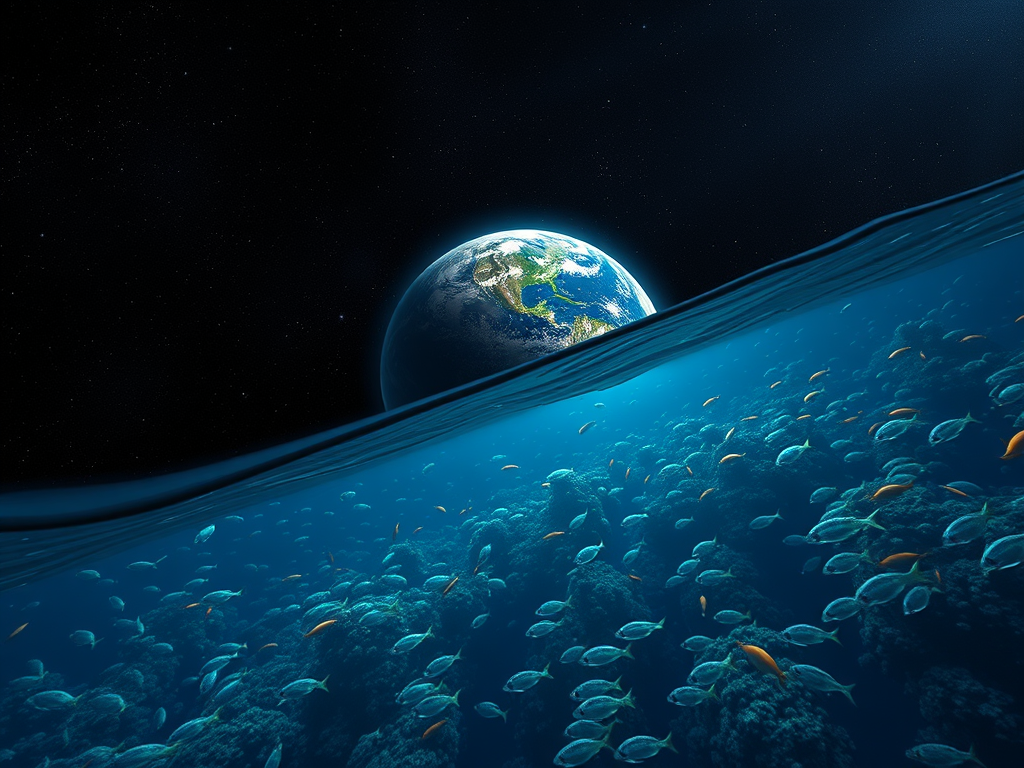
We often talk about the “Age of Discovery” as if it were a chapter in a dusty history book—a period of wooden ships and hand-drawn maps that ended once the last corners of the globe were colored in. But if you look at the pace of modern discovery, it becomes clear that we haven’t finished the map. We’ve simply changed the scale.
From the crushing depths of the midnight zone in our oceans to the silent, frozen craters of the lunar south pole, exploration remains the most powerful engine of human advancement. It isn’t just about “going places” it is about the radical transformation that happens to our technology, our perspective, and our survival as a species every time we push against the unknown.
The Spinoff Effect: Space Tech in Your Pocket
One of the most common myths about exploration—specifically space exploration—is that it is a “drain” on Earth’s resources. In reality, the quest to survive in the most hostile environments imaginable is what forces us to invent the tools we use in our most comfortable ones.
When engineers work to sustain life on a space station, they aren’t just building rockets. They are inventing water purification systems that are now used in remote villages across the globe. They are developing “food safety” sensors born from rover research that now protect our global supply chains. Even the camera in your smartphone exists because NASA needed tiny, high-quality imaging sensors for interplanetary missions. We explore the void to improve the backyard.
The Overview Effect: Changing the Human Perspective
There is a psychological phenomenon known as the Overview Effect. It is the cognitive shift reported by astronauts when they see the Earth hanging in the blackness of space—a tiny, fragile “blue marble” without borders.
This shift in perspective is perhaps the most profound “human” byproduct of exploration. It fosters a global identity that transcends local conflict. When we explore, we stop seeing ourselves as citizens of a single nation and start seeing ourselves as stewards of a single planet. This expanded consciousness is what drives international cooperation on climate change, disaster response, and global health. We have to leave home to truly understand how to protect it.
The Deep Sea: Our Planet’s Final Frontier
While we look to the stars, we often forget that over eighty percent of our own ocean remains unmapped and unexplored. The deep sea is not just a dark abyss; it is a biological library of untapped potential.
Exploration of hydrothermal vents has revealed organisms that survive in conditions we once thought impossible. These “extremophiles” are teaching us new ways to process waste, develop heat-resistant enzymes for industry, and even create a new generation of antibiotics. Every deep-sea expedition is a chance to find a biological “key” to a human problem. By exploring the depths, we are quite literally finding the medicine of the future.
Curiosity as an Evolutionary Survival Mechanism
On a fundamental level, humans are wired to explore. Evolutionary psychologists suggest that our “Seeking System”—the dopaminergic drive that rewards us for investigating the new—is what allowed our ancestors to survive changing climates and migrating predators.
In the modern world, this drive prevents “Civilizational Stagnation.” When a society stops exploring, it stops questioning. Exploration keeps the “mental muscles” of humanity flexible. It forces us to solve problems we didn’t know we had and prepares us for “Black Swan” events—unpredictable crises that require the exact kind of innovative thinking that exploration cultivates.
The Integration of Human and Machine
We are entering a new era where the “Explorer” is no longer just a person in a suit, but a partnership between human intuition and artificial intelligence. Autonomous underwater vehicles (AUVs) and robotic planetary scouts are now our “eyes” where humans cannot yet go.
This synergy is accelerating progress. We are now mapping ancient civilizations hidden under lakebeds and tracking subtle shifts in the Earth’s crust with radar observatories that can detect millimeters of movement from hundreds of miles away. This data isn’t just for curiosity; it’s for Resilience. It allows us to predict landslides, manage crop yields, and protect infrastructure before disaster strikes.
The Perpetual Horizon
Exploration is the ultimate long-term investment. It is the refusal to accept that we have seen enough or know enough. Every mission—whether it’s a probe to Venus or a submersible to the Mariana Trench—is a declaration of faith in the future.
We don’t explore because it is easy, or even because it is profitable in the short term. We explore because the act of reaching for the horizon is what makes us move forward. As long as there is a “there” that we haven’t been to, there is a “better” that we haven’t yet become.
#FutureOfExploration #SpaceScience #OceanDiscovery #HumanProgress #InnovationMindset
Disclaimer: This article provides an overview of scientific and exploratory trends for educational purposes. The impacts of specific missions and technologies are subject to ongoing research and peer review within the scientific community.
Leave a Reply