
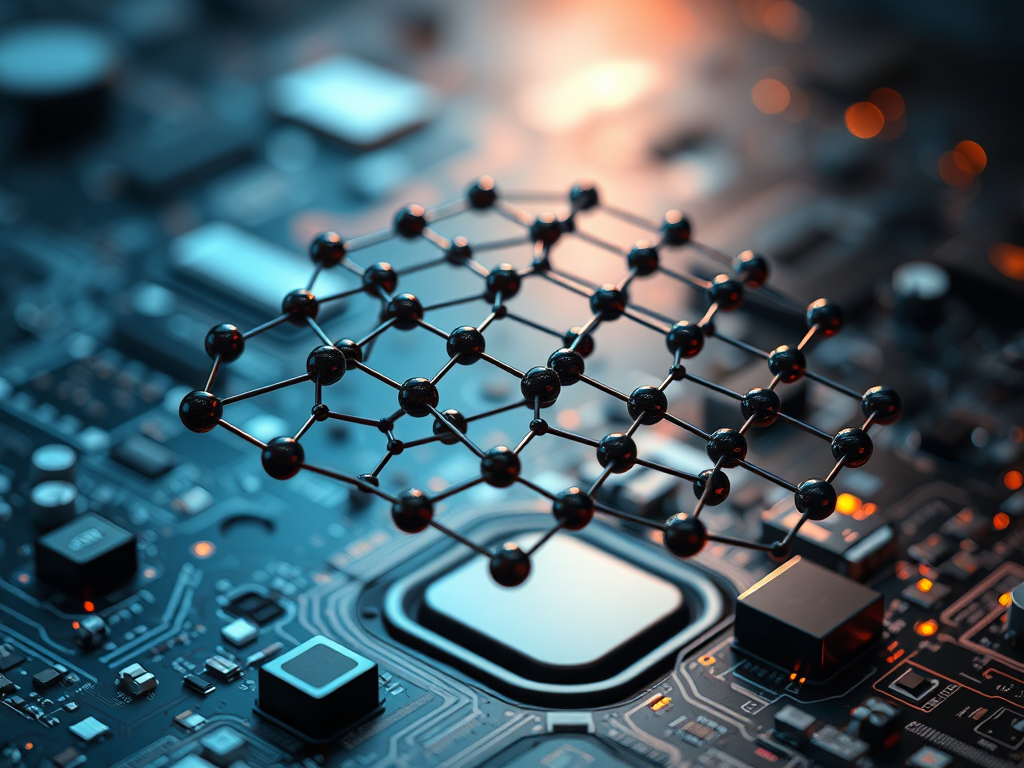
For decades, the march of technological progress has been a predictable one: smaller, faster, and more powerful. We’ve seen computers shrink from room-sized behemoths to pocket-sized marvels. Yet, this relentless pace of miniaturization is reaching its physical limits. The silicon chips that power our world are now so dense that the laws of physics themselves are becoming a barrier. This is the challenge of our time, but it’s also the dawn of a new era. The future of devices isn’t about making things a little smaller; it’s about building them from the ground up, atom by atom.
Welcome to the age of nanotechnology, a field that manipulates matter at the molecular scale to create materials and devices with unprecedented capabilities. Nanotechnology is not just an incremental step forward; it’s a fundamental shift that is poised to unlock a new universe of innovation. It’s the key to a world where our devices are not just smaller, but fundamentally smarter, more efficient, and seamlessly integrated into every aspect of our lives.
The Four Pillars of Nanotech’s Impact
The power of nanotechnology lies in its versatility. By controlling matter at the nanoscale—typically defined as dimensions between 1 to 100 nanometers—we can engineer materials with extraordinary properties. This is shaping the future across several critical domains.
1. Computing and Electronics: Pushing Past the Limit
The quest for faster computing is a primary driver of nanotechnology research. The traditional silicon transistor is approaching its physical minimum size, and the heat generated by these densely packed circuits is a major hurdle. Nanotechnology offers a radical solution. Researchers are developing next-generation components using advanced nanomaterials like graphene and carbon nanotubes. These materials boast exceptional electrical conductivity and a unique two-dimensional structure that allows for the creation of ultra-small, ultra-efficient transistors. This nanotech-driven leap will not only allow for more powerful processors but will also significantly reduce power consumption, extending the battery life of our devices.
Furthermore, the integration of nanotech with quantum computing is a revolutionary frontier. Nanoscale precision is essential for building and stabilizing qubits, the quantum equivalents of binary bits. This fusion of fields promises to create computers capable of solving problems that are intractable for today’s most powerful supercomputers, opening doors in everything from drug discovery to artificial intelligence.
2. Energy and Batteries: The Power to Last
The performance of our devices is only as good as their power source. Nanotechnology is fundamentally changing the way we generate, store, and consume energy. Battery technology is a key area of innovation, with nanostructured materials allowing for higher energy density and faster charging times. By designing materials with a greater surface-to-volume ratio, we can create batteries that hold more charge and replenish it in a fraction of the time.
Beyond batteries, nanotech is making energy harvesting more efficient. Nanostructured solar cells are being developed to capture more sunlight and convert it into electricity with higher efficiency. Additionally, piezoelectric nanogenerators can convert the mechanical energy from everyday movements into electricity, potentially powering wearable devices with a simple flick of the wrist. These innovations will not only lead to devices that last longer but will also make our relationship with energy more sustainable.
3. Sensors and Communication: A More Aware World
The Internet of Things (IoT) is built on the ability of devices to sense and communicate with their environment. Nanotechnology is enabling the creation of sensors that are smaller, more sensitive, and more versatile than ever before. Nanoscale biosensors are being developed to detect biomarkers of diseases at the cellular level, allowing for incredibly early and accurate diagnostics from just a single drop of blood. In the medical field, this is leading to a new generation of wearable and implantable biosensors that can continuously monitor our health in real-time, sending data to healthcare providers for proactive care.
For communication, nanoscale antennas and other components are being developed to make wireless communication more efficient and powerful. This will lead to faster data transfer rates and a more robust network, seamlessly connecting our devices and making our digital world feel truly integrated into our physical environment.
4. Medical and Health Devices: A New Frontier in Healing
Perhaps the most impactful application of nanotechnology is in medicine. The ability to manipulate matter at the molecular level allows us to design tools and treatments with unparalleled precision. Nanobots are a concept moving closer to reality, with research into nanoscale robots capable of performing tasks at the molecular level, from delivering drugs directly to a tumor site to performing minimally invasive surgery. This targeted drug delivery minimizes side effects and maximizes the effectiveness of treatments. A tangible example of this is the development of self-amplifying mRNA vaccines, delivered in lipid nanoparticles, which has already transformed the field of infectious disease.
Furthermore, nanomaterials are being used to create scaffolds for tissue engineering, offering hope for repairing or replacing damaged tissues and organs. This is not just about treating disease; it is about rebuilding and regenerating the human body itself.
Challenges and a Human-Centered Vision
While the potential of nanotechnology is boundless, its development is not without its challenges. The ethical and safety implications of creating and deploying new nanomaterials require rigorous research and a transparent, public conversation. The potential for environmental or health risks must be carefully assessed, and the challenges of large-scale, affordable manufacturing must be overcome.
However, these are the solvable problems of a nascent field. The ultimate vision of nanotechnology is not just about better gadgets but about a more intelligent, sustainable, and healthier world. It’s about building a future where technology is a natural extension of our lives—invisible, intuitive, and in service of our well-being.
Nanotechnology is the foundation of a new era of devices. By mastering the very building blocks of matter, we are poised to create a future that is not only smaller in scale but infinitely larger in its possibilities.
#Nanotechnology #FutureTech #Nanotech #EnergyStorage #Biosensors
Leave a Reply