
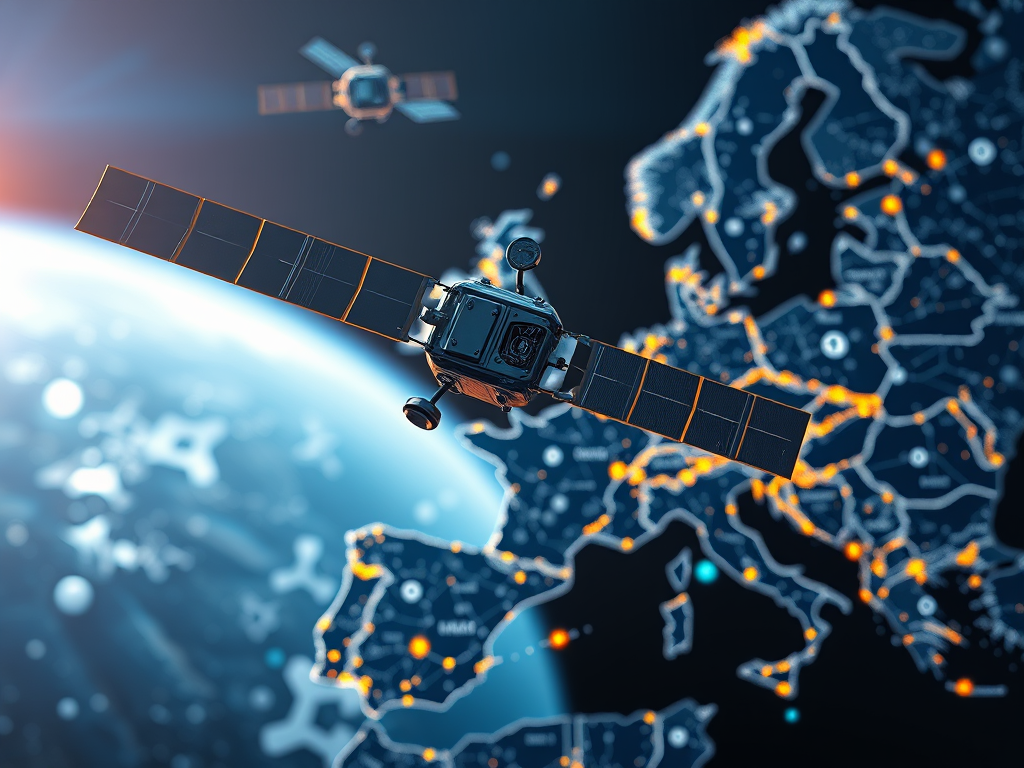
If you used a smartphone to find your way to a new cafe today, there is a high chance you weren’t just using American technology. By 2026, Europe’s own satellite constellation, Galileo, has become the world’s most precise civilian positioning system. While the world once relied solely on the US Global Positioning System (GPS), Europe decided that “good enough” wasn’t enough for our digital sovereignty.
More Than Just a Backup Plan
Galileo was born from a simple but vital realization: Europe could not afford to depend on a foreign military-controlled system for its critical infrastructure. Unlike the American GPS, which is operated by the US Department of Defense, Galileo is a purely civilian-controlled network managed by the European Union Agency for the Space Programme (EUSPA).+1
This independence is a strategic masterpiece. In a world where geopolitical tensions can lead to signal “jamming” or “spoofing” (the act of tricking a receiver with false signals), having a sovereign European system ensures that our ambulances, trains, and power grids keep running. This aligns with the EU Space Strategy, which prioritizes autonomy and security for all member states, from the bustling streets of Paris to the tech hubs in Riga.
Accuracy That Challenges the Giants
The most noticeable difference for the average user in 2026 is the sheer precision. While standard GPS typically offers an accuracy of about 3 to 5 meters, Galileo’s Open Service brings that down to under 1 meter. For professionals, the Galileo High Accuracy Service (HAS) is a game-changer, providing decimeter-level precision (about 20cm) for free.
Compare this to the US or Asia, where similar high-precision signals are often locked behind expensive subscriptions or restricted to specific regions. In Europe, this accuracy is being used by companies like Airbus in Germany to develop autonomous aircraft and by French logistics firms to track cargo with pinpoint reliability. Even in the Baltics, Estonian startups are leveraging this data to create smarter, more efficient urban delivery drones.
The Invisible Engine of the European Economy
You might not see the 26+ satellites orbiting 23,222 km above us, but you certainly feel their impact. Galileo is now integrated into almost every new smartphone and vehicle sold in the EU. This isn’t just about convenience it is about a massive economic boost. It is estimated that the “downstream” market (the apps and services built on this data) contributes billions to the European GDP.
Specific regulations, such as the eCall mandate, require all new cars sold in the EU to be Galileo-compatible. This system automatically dials emergency services in a crash, sending the vehicle’s exact location. Because Galileo’s signals are stronger in “urban canyons” (streets with tall buildings), it can find a crashed car in downtown Berlin much faster than older systems could.
A Search and Rescue Superhero
One of Galileo’s most heartwarming success stories is its Search and Rescue (SAR) service. Europe’s system is unique because it features a “Return Link” function. When a hiker in the snowy forests of Latvia or a sailor in the Mediterranean triggers a distress beacon, the Galileo satellites don’t just pick up the signal. They send a confirmation message back to the beacon, letting the person in trouble know that help is on the way. This simple “message received” can be the difference between panic and hope in a life-threatening situation.+1
Looking Up: What Is Next?
As we move further into 2026, the Galileo Second Generation satellites are already being prepared for launch. These will be even more flexible, with the ability to be updated while in orbit to tackle new cybersecurity threats. Europe didn’t just build an alternative to GPS we built a superior successor that puts civilian needs first.+1
With Galileo now providing 20cm accuracy for free, do you think we are ready to trust fully autonomous cars on our city streets, or is human control still irreplaceable?
#GalileoGNSS #EuropeanSpace #TechIndependence #SatelliteNavigation #EUSpace
Leave a Reply