
CATEGORY: Space & Astronomy | Feereet.com
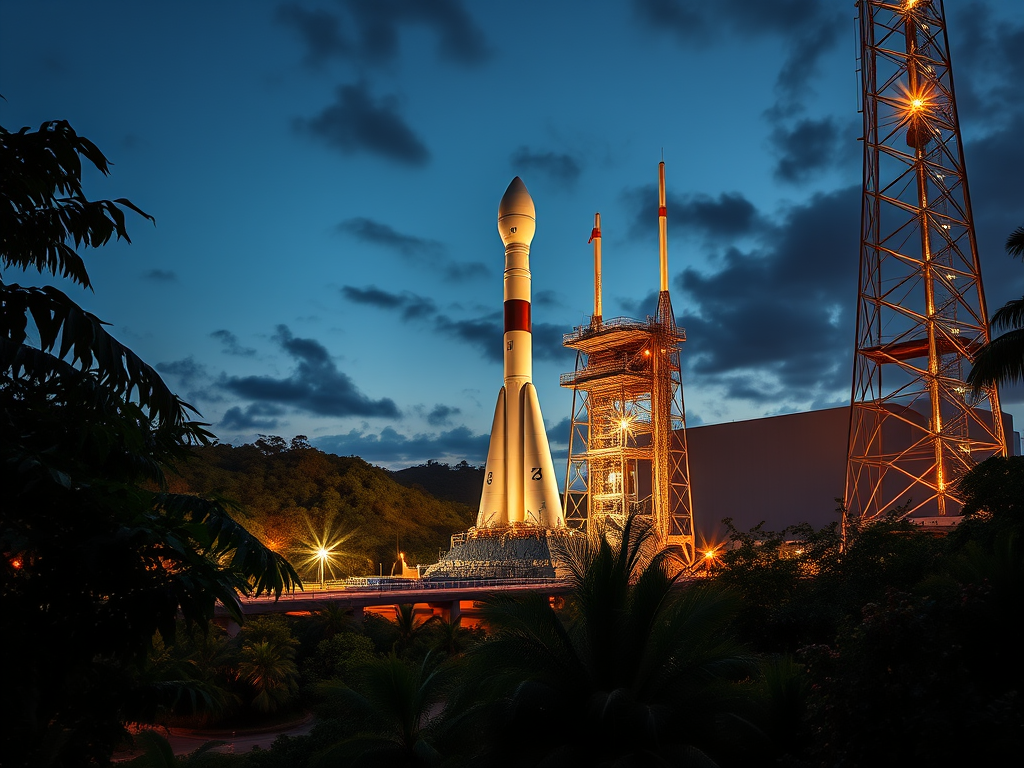
A rocket launching from the jungles of French Guiana might feel like a distant spectacle with no connection to your morning commute in Tallinn or your online banking in Warsaw. It is not. Ariane 6 is about whether Europe can place its own satellites into orbit without depending on any other country’s rockets, politics, or pricing. In 2026, that question has never been more urgent.
What Ariane 6 Actually Is
Ariane 6 is Europe’s newest heavy-lift launch vehicle, a rocket designed to carry large satellites and payloads into orbit. It is built by ArianeGroup, a joint venture between Airbus and Safran, and launches from the Guiana Space Centre in Kourou, French Guiana, managed by the French space agency CNES on behalf of ESA (the European Space Agency).
The rocket comes in two versions. The Ariane 62 carries lighter loads using two solid rocket boosters (extra propulsion units attached to the main body for additional thrust at launch). The Ariane 64 uses four boosters and can lift approximately 11.5 tonnes to geostationary transfer orbit (the trajectory used to reach the high altitude where communications satellites operate). Its upper stage engine can be restarted multiple times during a single flight, allowing one rocket to deploy several satellites to completely different orbits in one mission. No previous European rocket could do this.
Ariane 6 made its first successful launch in July 2024 after years of delays. Those delays had consequences that went far beyond embarrassment.
The Moment Europe Lost Its Launch Independence
To understand why Ariane 6 matters, you need to understand what happened when it was not ready.
When Russia launched its full-scale invasion of Ukraine in February 2022, ESA was still relying on Russian Soyuz rockets to launch certain European satellites. Within weeks, Russia withdrew its Soyuz rockets from the Kourou launch site entirely. Several European satellites, including hardware for the Galileo navigation system (Europe’s own satellite GPS network that your phone likely uses daily) were grounded with no confirmed launch path.
This was not a theoretical scenario playing out in a policy paper. It was a real strategic dependency failing in real time during a geopolitical crisis. Europe, with one of the world’s most respected space agencies and decades of space heritage, could not put its own satellites into orbit without asking another country for a lift.
The Ariane 5 rocket retired in 2023 before Ariane 6 was ready, leaving a gap. During that window, some European institutional payloads turned to SpaceX. The optics and the strategic logic of that were uncomfortable for anyone who cares about European autonomy.
Ariane 6 closes that gap. Not perfectly or cheaply. But it closes it.
Three European Stakes That Make This Personal
Germany’s Satellite Industry Needs a Reliable Launcher
Germany hosts some of Europe’s most important satellite manufacturers. OHB in Bremen and Airbus Defence and Space in Munich and Friedrichshafen build spacecraft for scientific, Earth observation, and communications missions. For these companies, the launcher question is not abstract. When Ariane 5 retired and Ariane 6 was delayed, German manufacturers faced genuine uncertainty about timelines and costs for getting their satellites to orbit.
Ariane 6 restores a predictable European option. Not because foreign launchers are necessarily unreliable but because European companies have legitimate industrial, legal, and strategic reasons to prefer launching on European infrastructure when it is available and capable.
France’s Long-Term Commitment
France has been the most consistent financial backer of European launch capability throughout ESA’s history. The Guiana Space Centre employs hundreds of people in a French overseas territory and anchors an industrial supply chain extending across French and European aerospace. France’s investment in Ariane 6 development reached several billion euros, and the French government has been explicit that independent launch access is a national strategic priority with consequences for defence, telecommunications, and digital infrastructure.
Without Ariane 6 flying regularly, the entire Kourou operational ecosystem becomes harder to sustain economically. The rocket’s commercial success is therefore tied directly to the viability of infrastructure that Europe has spent decades building.
The Baltic Connection Through Small Satellites
Estonia and Latvia are not rocket-launching nations but they have growing stakes in the European space economy. Estonian university teams and startups have built and launched CubeSats (small standardised satellite platforms used for research and commercial applications). Latvian technology companies have developed components and software for European space missions.
As Ariane 6 begins flying regularly in 2026, its ability to carry small satellites as secondary payloads alongside primary missions creates affordable access opportunities for Baltic and other smaller European space actors. A healthy European launcher means a healthier European small satellite ecosystem, and that ecosystem directly supports the Earth observation and satellite data services that Baltic companies are increasingly building commercial products around.
Ariane 6 vs. SpaceX: The Honest Assessment
The comparison with SpaceX’s Falcon 9 is unavoidable and deserves honesty rather than defensiveness.
SpaceX currently dominates global commercial launch in a way that is genuinely impressive. In 2024 SpaceX conducted well over 100 orbital launches. The Falcon 9’s reusability (landing and reflying rocket boosters rather than discarding them after each flight) has dramatically reduced launch costs. Ariane 6 in its current design is expendable, meaning a new rocket is manufactured for every mission. This makes its per-launch cost significantly higher than a reused Falcon 9 booster.
Ariane 6 cannot currently compete with Falcon 9 on pure commercial price for customers with no preference about which country’s rocket they use. ArianeGroup and ESA acknowledge this openly and are studying reusability options for future rocket evolution, but those developments are several years away.
Where Ariane 6 competes is in European institutional payloads, specialised orbit deployment using its restartable upper stage, and the provision of launch access that does not depend on American political decisions, export licences, or commercial priorities. When the US government decides to restrict launch services, or when a commercial provider prioritises its own constellation over customer payloads, Europe needs an alternative. Ariane 6 is that alternative.
The strategic case for sustaining the investment is straightforward. The cost of losing independent launch capability is not just the money saved on cheaper launches. It is the permanent loss of a capability that takes decades to rebuild if it is ever allowed to atrophy.
More Than Hardware
Ariane 6 represents a decision about what kind of actor Europe wants to be. Not a consumer of other nations’ space infrastructure but a sovereign participant with the capability to reach orbit on its own schedule, under its own law, and with its own industrial base.
The Galileo satellites that navigate your car, the Copernicus satellites that monitor European floods and wildfires, the communications infrastructure underlying European financial systems. All of it depends on the ability to replace ageing hardware with new satellites when the time comes. Ariane 6 is how Europe does that without asking permission.
In 2026, with geopolitical uncertainty at levels not seen since the Cold War, that independence is worth more than any launch cost comparison suggests.
💬 Here is the question worth thinking about: Given that SpaceX currently offers cheaper launches than Ariane 6, should European taxpayers keep funding independent launch capability as a strategic investment, or is the dependency risk overstated? And does the Soyuz situation in 2022 change your answer? Tell us in the comments.
Leave a Reply